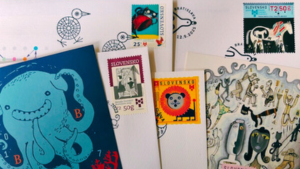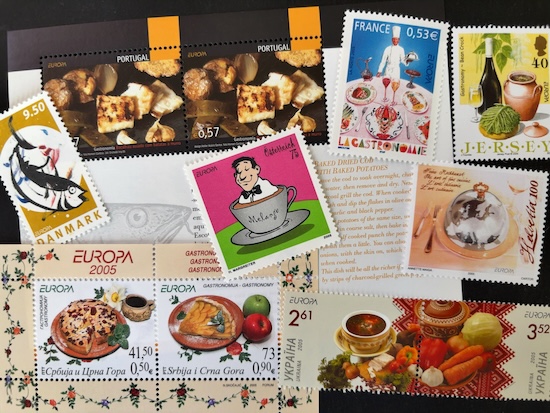
Every year, European postal services issue stamps sharing a common theme — the EUROPA series.
The 2005 theme was Gastronomy.
Gastronomy is the art of appreciating food in its relationship to culture, history, and terroir — experiencing a meal as a holistic combination of art and scholarship. It goes beyond simply enjoying fine dining to encompass the stories of ingredients, the land they come from, and the cultural context they carry.
Each country poured its own culinary heritage into these stamps — through photographs, illustrations, paintings, cartoons, and even recipes — creating a miniature food-and-culture encyclopedia you can hold in your hand.
In this post, I’ll introduce all 58 countries that were members of PostEurop at the time!
1 🇦🇲 Armenia
Lavash and Harissa
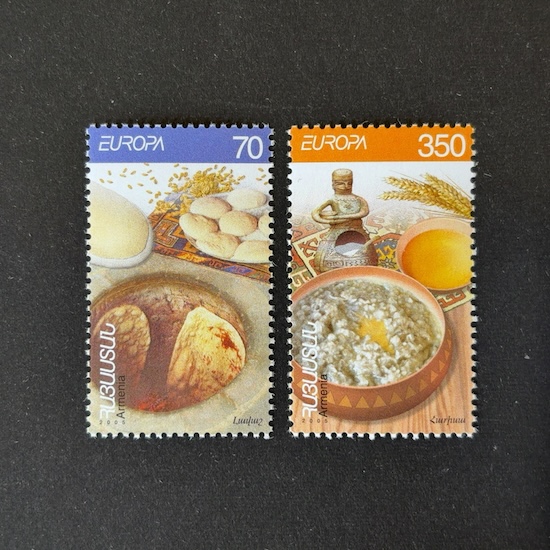
Armenia’s stamps feature Lavash, a thin flatbread inscribed on UNESCO’s Intangible Cultural Heritage list, and Harissa, a slow-cooked porridge of wheat and chicken. Lavash is baked by slapping the dough against the inner wall of a clay oven, and is traditionally served alongside Harissa at festivals and after fasting periods. Two dishes that reflect the crossroads of Middle Eastern, Mediterranean, and Central Asian food cultures.
2 🇦🇱 Albania
Meat Stew and Byrek
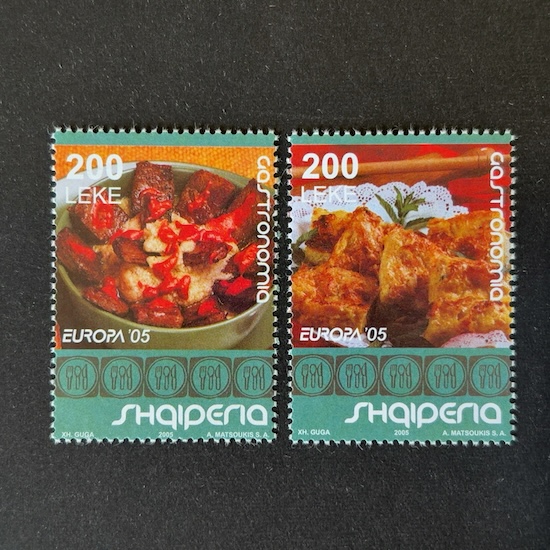
Albania’s stamps (200 lekë × 2) carry the word “Gastronomia.” They depict a spicy tomato-based meat stew and Byrek, a baked pastry filled with spinach and white cheese — Albania’s iconic street food. A dish that draws on Balkan culinary influences while retaining its own distinct flavour.
Sarma (Cabbage Rolls)
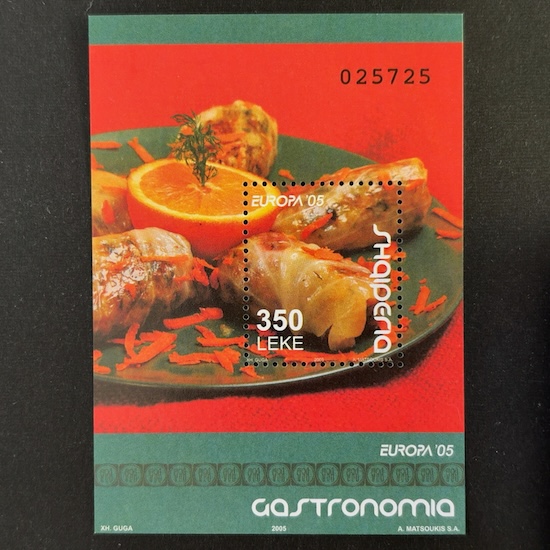
A second stamp shows Sarma — meat and rice wrapped in cabbage leaves, beloved across Albania and Turkey alike.
3 🇦🇹 Austria
Viennese Melange

A humorous illustration of a waiter balancing a coffee cup on his head. The cup reads “Melange” — espresso topped with steamed and foamed milk, the signature drink of Vienna’s coffeehouse culture. Vienna’s café tradition has been a “second living room” for intellectuals and artists for over 150 years, and is now recognised as UNESCO Intangible Cultural Heritage.
4 🇦🇿 Azerbaijan
Dolma and Plov
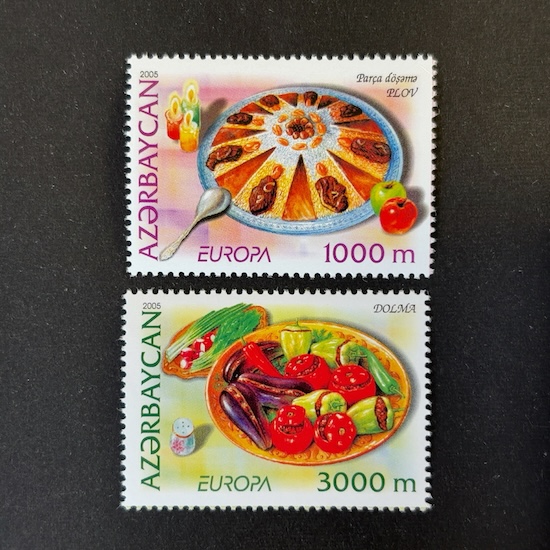
Vegetable Dolma (3000m) — grape leaves or peppers stuffed with meat and rice — and Plov, a saffron-scented festive rice dish. Azerbaijan’s Dolma is inscribed on UNESCO’s Intangible Cultural Heritage list. The rich flavours of a nation at the crossroads of the Silk Road.
5 🇧🇾 Belarus
Vegetables and Black Bread
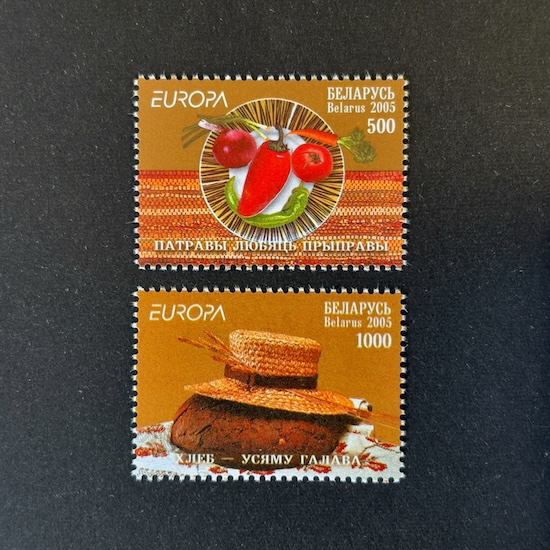
A sturdy dark rye loaf alongside vibrant red, white, and green vegetables. The stamp reads “Хлеб — усіму галава” (Bread is the head of everything). A simple but profound expression of gratitude for the earth’s gifts — rye bread is the cornerstone of the Eastern European table.
6 🇧🇪 Belgium
Clara Peeters’ Still Life Paintings
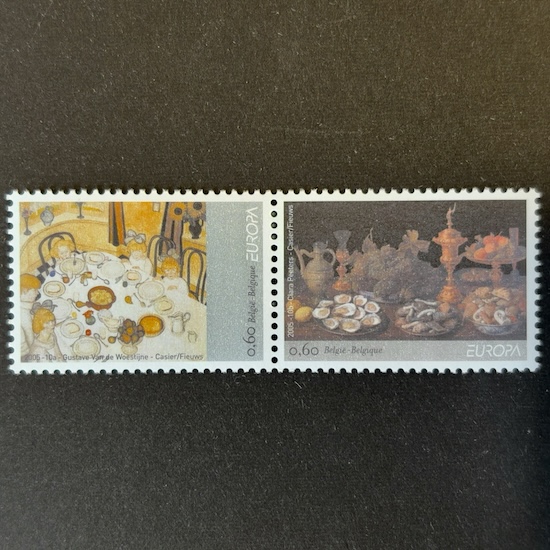
A pair of stamps reproducing still life paintings by 17th-century Flemish artist Clara Peeters (1594–1657), depicting oysters, vessels, and tablecloths with extraordinary precision. Rather than chocolate, beer, or waffles, Belgium chose the perspective of “17th-century banquet culture” — a testament to Flemish depth of appreciation for both food and fine art.
7 🇧🇬 Bulgaria
Traditional Dishes
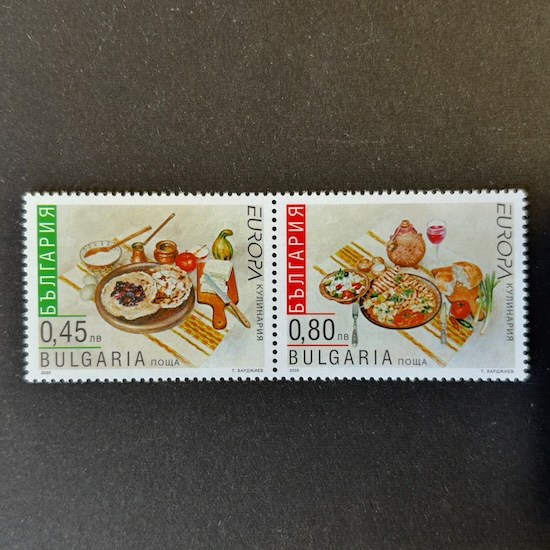
Two traditional dishes served in ceramic bowls, with the word “Кулинария” (Culinary art). Bulgaria is where Lactobacillus bulgaricus — the yoghurt bacterium — was discovered. Known for Shopska salad (tomatoes, cucumber, white cheese) and Banitsa (cheese-filled pastry).
8 🇧🇦 Bosnia and Herzegovina
Traditional Meat Dishes in Silverware
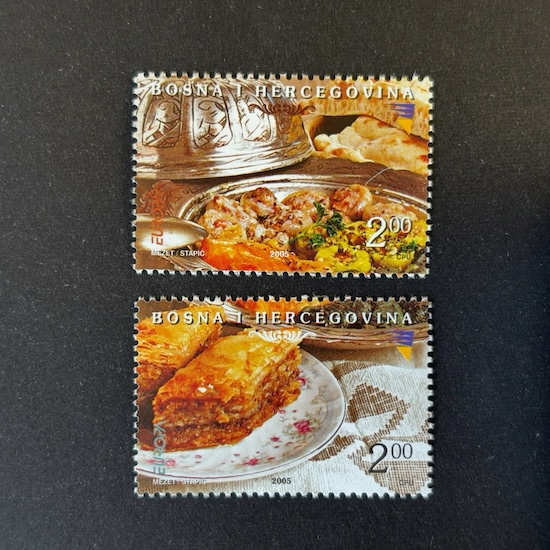
Two meat dishes elegantly presented on silver serving ware. Bosnian cuisine bears the strong imprint of Ottoman culinary culture — Ćevapi (grilled minced meat), Burek (meat pastry), and dishes rich in spices and charcoal grilling. A dignified presentation evoking a traditional feast.
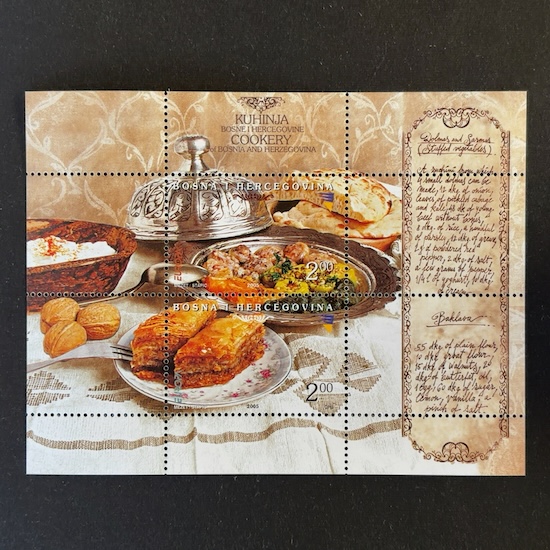
The miniature sheet version features silver candlesticks and dishes spread luxuriously across the wider format, with what appears to be a handwritten recipe text below.
9 🇭🇷 Croatia
Bread and Wine: KRUH and VINO
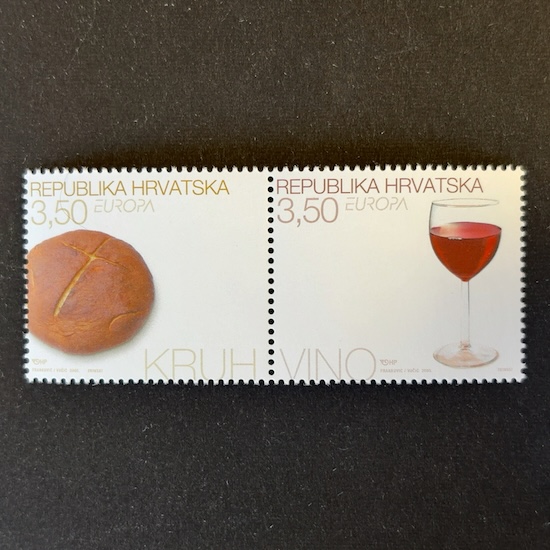
A strikingly minimal stamp: against a white background, only a round brown loaf “KRUH” and a wine glass “VINO.” Bread and wine carry religious symbolism, but here they are presented proudly as the foundations of Mediterranean food culture. Croatia’s wine-growing tradition stretches back to ancient Rome. A refined minimalist design that catches the eye.
10 🇨🇾 Cyprus
Day and Night at the Table
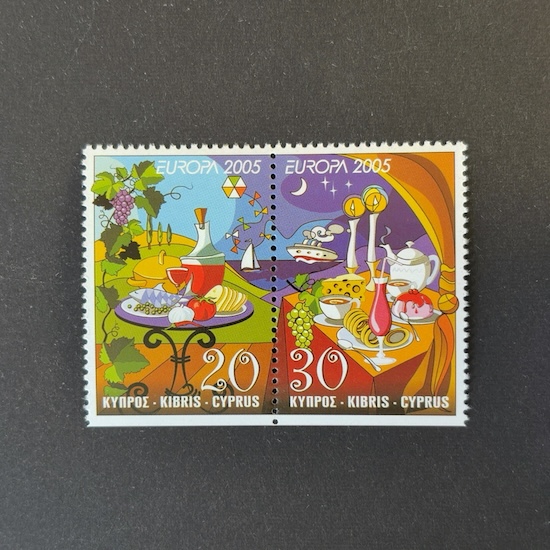
A vivid pair of illustrations: on the left, a midday meze (assorted appetisers) enjoyed under a vine-covered terrace in Mediterranean sunshine; on the right, an evening feast by candlelight. Cyprus has a unique food culture shaped by both Greek and Turkish traditions. Its Halloumi cheese — which doesn’t melt when grilled — is now beloved around the world.
11 🇨🇿 Czech Republic
Beer, Roast Chicken, and Knedlíky
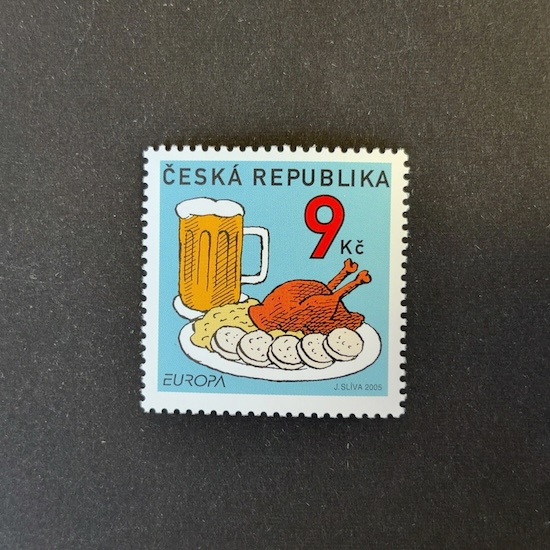
A humorous illustration by cartoonist J. Slíva: a foaming beer mug, a whole roast chicken, and Knedlíky (bread dumplings) on a plate. The Czech Republic is one of the world’s top beer-consuming nations and the birthplace of Pilsner lager. Knedlíky soak up the sauces of goulash beautifully — a classic Bohemian accompaniment rendered in comedic style.
12 🇩🇰 Denmark
Hot Dog and Herring
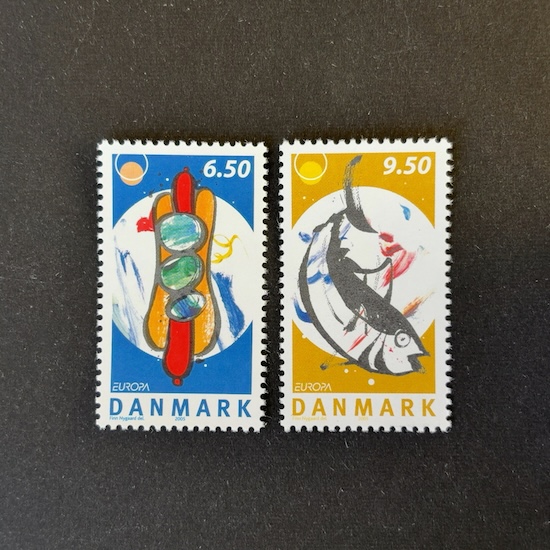
Abstract, contemporary-art-style illustrations of the Danish Pølse (hot dog) and a leaping fish. The hot dog has been a beloved Copenhagen street food since the late 19th century. Sandwiched between the North Sea and the Baltic, Denmark is also a great fishing nation — pickled herring (Sild) and smoked salmon form the backbone of its food culture. A pop, dynamic design that really stands out.
13 🇫🇴 Faroe Islands
A Feast of Traditional Seafood and Meat
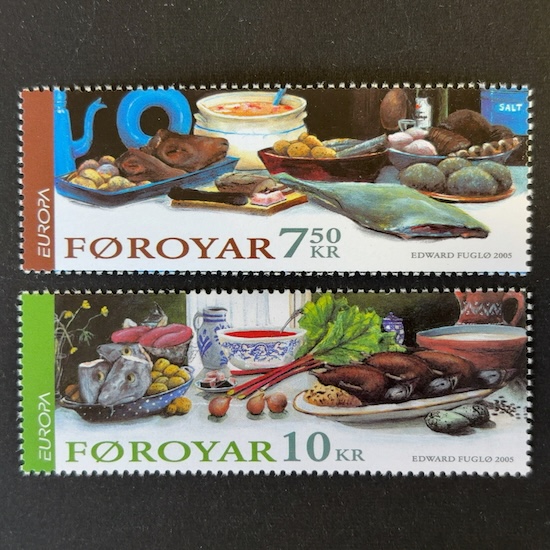
A pair of realistic still life paintings by artist Edward Fuglø: dried fish, salted meat, root vegetables — the sparse, honest table of the North Atlantic. Faroese food culture centres on preserved foods for surviving long winters: salt-dried fish, wind-dried mutton (skerpikjøt), and fermented lamb. A quietly powerful pair of stamps.
14 🇬🇱 Greenland
Musk Ox Meat
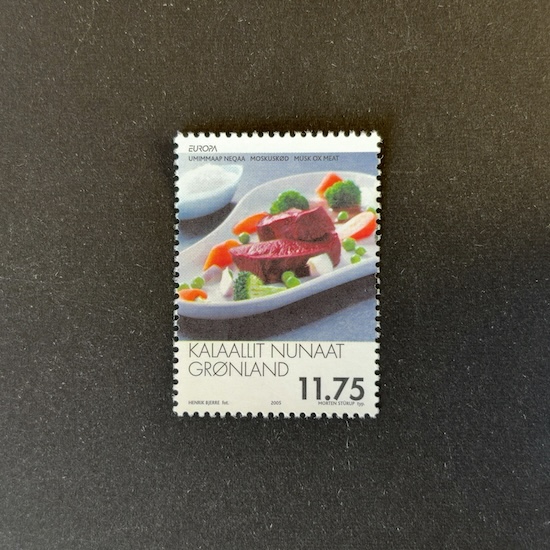
Labelled “Musk Ox Meat,” a deep-red cut of meat is beautifully plated with vegetables. The indigenous Kalaallit (Inuit) people have long relied on wild animals for sustenance. Musk ox is a lean, richly flavoured game meat. A stamp where modern Greenlandic cuisine and ancient tradition coexist in perfect balance.
15 🇪🇪 Estonia
Kokakunst: The Art of Cooking
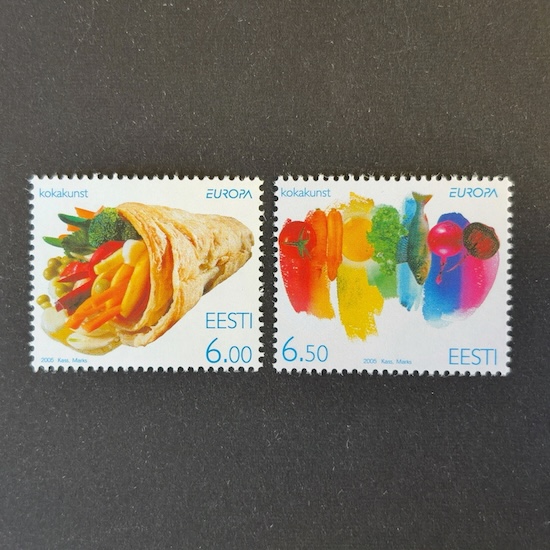
The word “Kokakunst” (The Art of Cooking) appears alongside a colourful vegetable wrap and a rainbow of vegetables and fish. Estonia, at the northern tip of the Baltic states, has a food culture shaped by Swedish, German, and Russian influences. “Food is art” — the stamp projects the creativity and innovation of modern Estonian cuisine.
16 🇫🇮 Finland
Traditional Finnish Cuisine
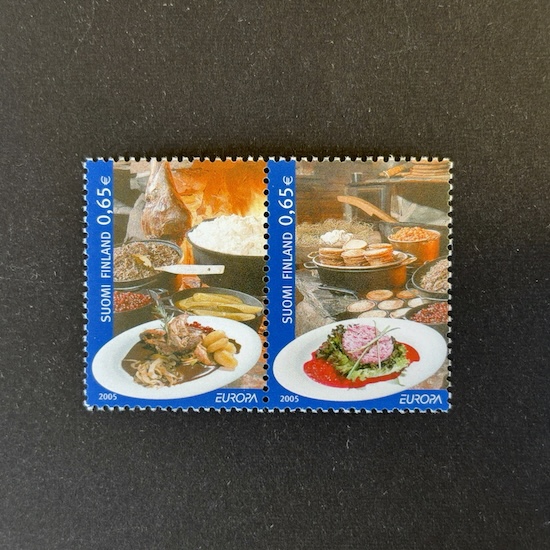
Two photographs: traditional cooking vessels by a wood-fired oven, and beautifully plated dishes. Finnish food culture is described by the spirit of “metsän antimet” — the gifts of the forest. Cloudberries, chanterelles, salmon, rye bread, Karelian pasties — a table born from living in harmony with nature.
17 🇦🇽 Åland Islands
Smoked Fish

Three golden smoked fish by artist Juha Pykäläinen, striking against a deep purple-blue background. The Åland archipelago is a fishing community in the Baltic Sea. Smoked fish is a common Scandinavian tradition — herring, salmon, and trout have long been processed in traditional smokeries along the shore. A bold, powerful stamp that speaks of Åland’s maritime culture.
18 🇫🇷 France
La Gastronomie
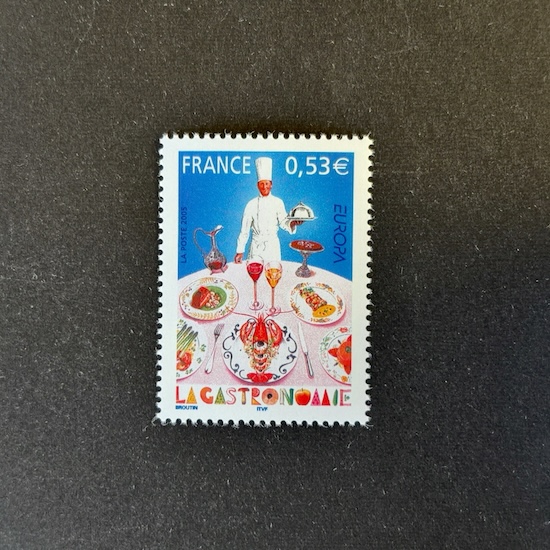
The words “LA GASTRONOMIE” dominate the stamp. A chef in a white toque holds a silver cloche aloft, while lobster, wine, and colourful dishes fill the table. French cuisine underpins the entire Western culinary tradition, and its food culture is recognised as UNESCO Intangible Cultural Heritage. From Escoffier’s classical codification to the revolution of Nouvelle Cuisine — France’s pride in food overflows from every corner of this stamp.
19 🇦🇩 Andorra (French Post)
Bodegó (Still Life)
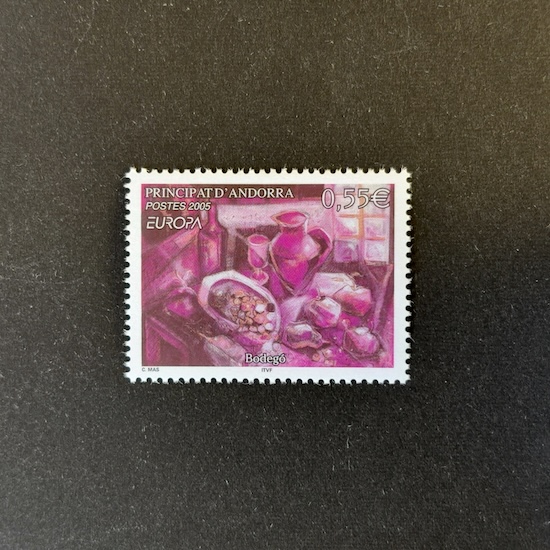
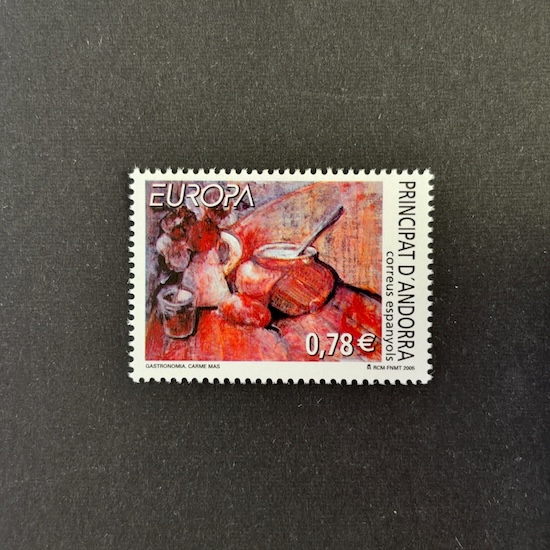
An abstract still life “Bodegó” in deep purples and crimsons — jars, vessels, and fruit in the traditional Catalan still-life style. Andorra blends the cuisines of France and Spain (Catalonia), with duck confit and mountain game at its heart. Compare this with stamp #53 (Spanish Post Andorra) to see the fascinating difference in French and Spanish artistic sensibilities.
20 🇬🇪 Georgia
Georgian Bread
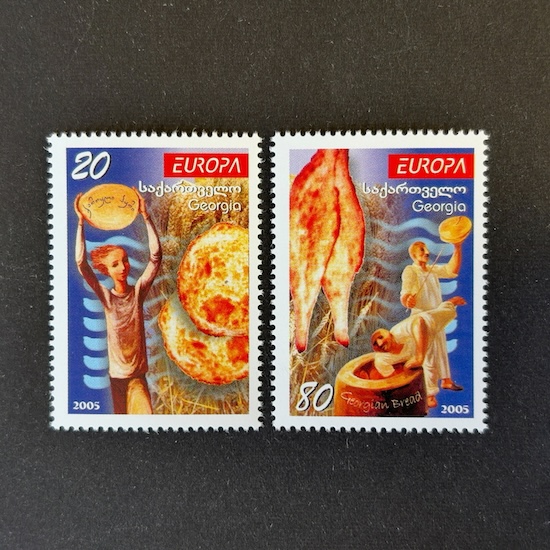
A pair of stamps reading “Georgian Bread“: an artisan baking in a wood-fired clay oven, and golden loaves fresh from the fire. Georgian breads are wonderfully varied — boat-shaped Shoti, cheese-filled Khachapuri, and many more. Georgia is also home to one of the world’s oldest wine-making traditions, stretching back over 8,000 years.
21 🇩🇪 Germany
Gastronomy: Simple Richness
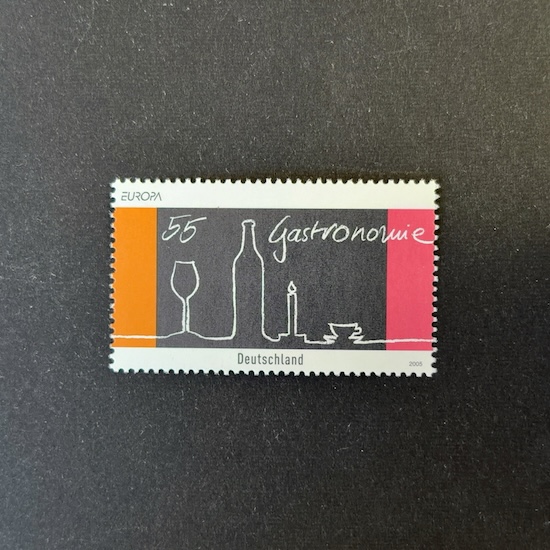
Against a black background, white line drawings of a wine glass, a bottle, a candle, and a teacup, with a hand-lettered “Gastronomie.” Rather than depicting food itself, Germany chose to evoke the atmosphere of dining — a distinctly Bauhaus sensibility. Germany reportedly has one of the highest concentrations of Michelin-starred restaurants in Europe.
22 🇬🇧 Great Britain
Changing Tastes in Britain

A set of six stamps on the theme “Changing Tastes in Britain“: a woman eating curry, a woman with a teacup, a boy eating sushi with chopsticks, a woman enjoying pasta and wine, a woman with chips, and a man with fruit. Once stereotyped as a nation indifferent to food, Britain has been transformed by its immigrant communities into one of the most gastronomically diverse countries in the world.
23 🇬🇮 Gibraltar
A Crossroads of Mediterranean Food Cultures
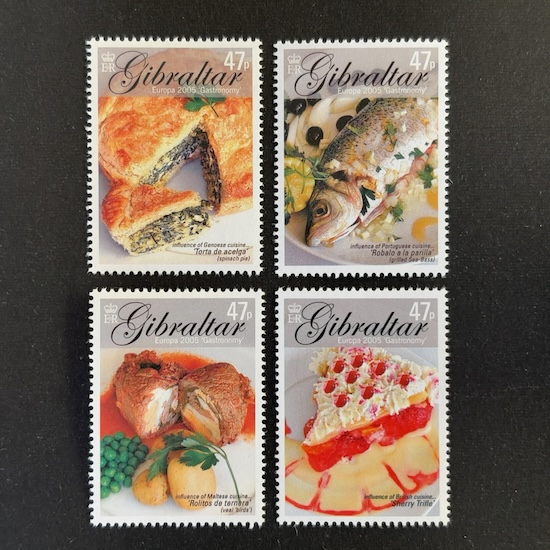
Four stamps trace four culinary influences on Gibraltar:
- Genoese: Torta de acelga (chard pastry)
- Portuguese: Robalo a la parilla (grilled sea bass)
- Maltese: Rolitos de ternera (veal rolls)
- British: Sherry Trifle
Perched at the gateway to the Mediterranean, Gibraltar is a true melting pot of Italian, Portuguese, Maltese, and British food cultures — and these four stamps map that delicious history.
24 🇬🇬 Guernsey
Gifts of the Sea and Island
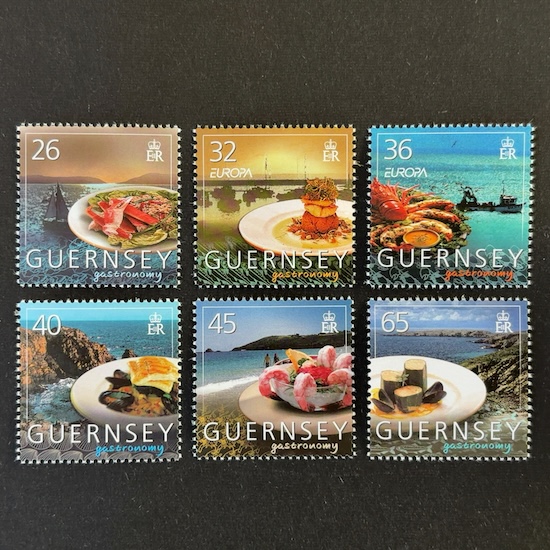
Six stamps set against island landscapes: lobster, shellfish, and fresh seafood beautifully plated. Close to the Normandy coast, Guernsey enjoys rich fishing grounds and fertile farmland. The famous Guernsey cow gives exceptionally rich cream and butter, while fresh seafood underpins island cooking. A table where French and British food cultures mingle delightfully.
25 🇯🇪 Jersey
Four Jersey Specialities
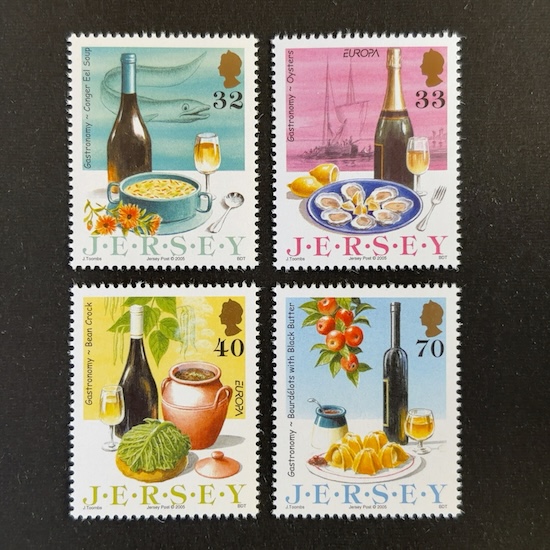
Four local specialities from Jersey:
- Conger Eel Soup — a Jersey island tradition
- Oysters — the fresh bounty of the island
- Bean Croak — a humble home-cooked dish
- Bourdélots with Black Butter — apple dumplings with Jersey’s famous long-cooked apple spread
A small island, but a proudly independent food culture shines through all four stamps.
26 🇮🇲 Isle of Man
Junior Masterchef
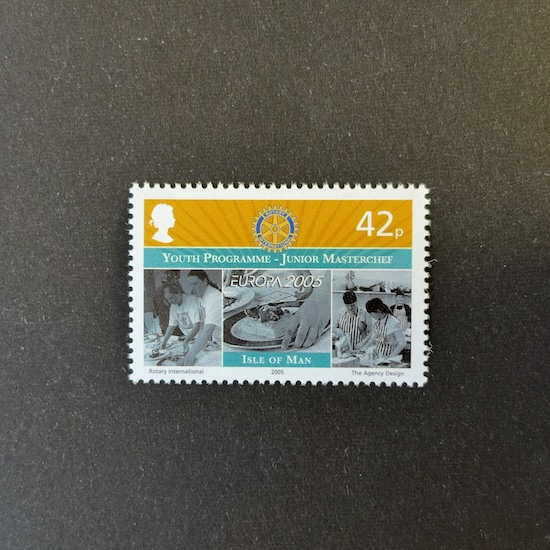
Bearing the Rotary International logo, these stamps feature the “Youth Programme — Junior Masterchef” in three black-and-white photographs of young people learning to cook. Rather than depicting food itself, the Isle of Man chose “education and youth development through food” — a distinctive approach that speaks to the importance of passing culinary traditions to the next generation.
27 🇭🇺 Hungary
Gulyás (Paprika Stew)
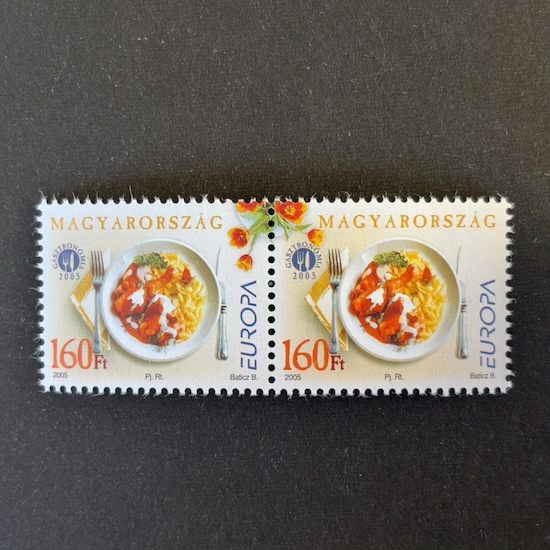
A matching pair: a rich paprika-red meat stew with noodles and sour cream. Hungary is a world-class paprika producer. Gulyás (known abroad as Goulash), originally a herdsmen’s campfire dish, is recognised around the globe as the symbol of Hungarian cuisine.
28 🇬🇷 Greece
Ntakos and a Tomato-Feta Recipe
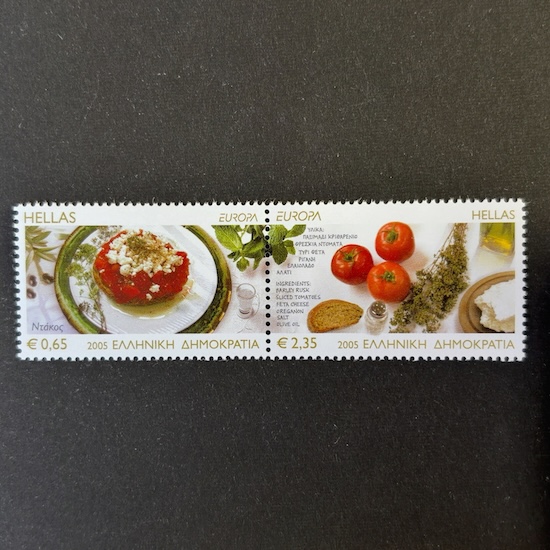
Cretan Ntakos — dried bread topped with tomato, feta, and oregano — photographed alongside its ingredients and recipe in both Greek and English. The Mediterranean diet (olive oil, feta, fresh vegetables) is recognised as UNESCO Intangible Cultural Heritage. A beautiful, sun-drenched stamp.
29 🇮🇸 Iceland
Matargerðarlist: The Art of Cooking
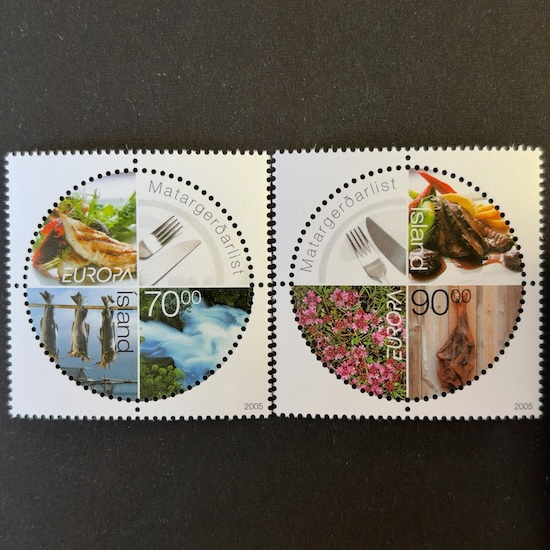
Two circular designs under the theme “Matargerðarlist” (The Art of Cooking): fish dishes, dried fish, smoked lamb (Hangikjöt), waterfalls, and wildflowers — all intertwined. Iceland’s food culture is defined by the bounty of the North Atlantic and geothermal-grown produce. Hangikjöt, a traditional Christmas dish of smoked lamb, is a cultural centrepiece. The circular design is visually stunning.
30 🇮🇪 Ireland
Irish Stew and Oysters
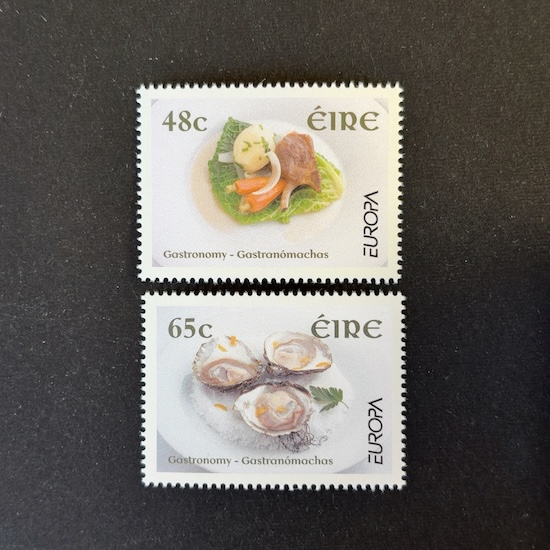
Two photographs (48c · 65c): a hearty vegetable and meat stew, and freshly shucked oysters on a white plate. Irish Stew — lamb, potatoes, and onions simmered simply — is the soul dish of Ireland. Galway oysters draw enthusiasts from around the world each September for the International Oyster Festival. For a nation shaped by the Great Famine (1845–1852), food carries profound meaning.
31 🇮🇹 Italy
Wheat and Grapes: Pride of Agriculture
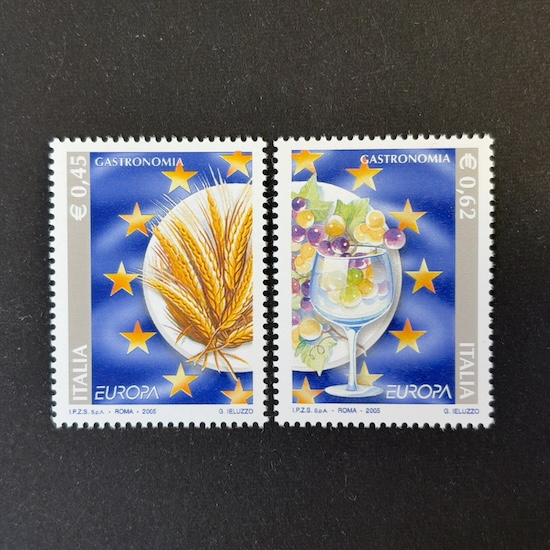
Against a background of EU stars and the word “GASTRONOMIA“: golden wheat ears and a wine glass of grapes. By depicting the raw ingredients symbolically, Italy expresses the richness of its agriculture. One of the world’s largest wine producers, and home to pasta, pizza, cheese, and prosciutto — Italy also invented the DOP (Protected Designation of Origin) system, a testament to its pride in food and terroir.
32 🇰🇿 Kazakhstan
Qymyz and Horses
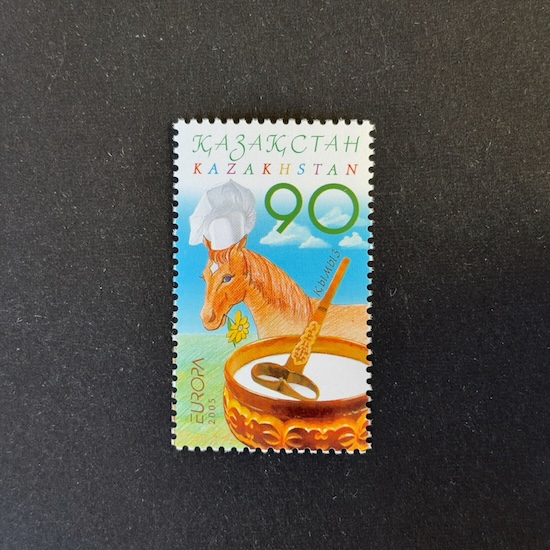
Horses galloping across the steppe, a wooden barrel of Qymyz, and a long wooden stirring rod. Qymyz is fermented mare’s milk — a symbol of Central Asian nomadic culture, slightly alcoholic, highly nutritious, and once used as medicine. In Kazakhstan, horses remain central to food culture: horse meat (Qazy) and horse sausage (Shuzhuk) are traditional delicacies.
33 🇱🇻 Latvia
A Folk-Style Still Life
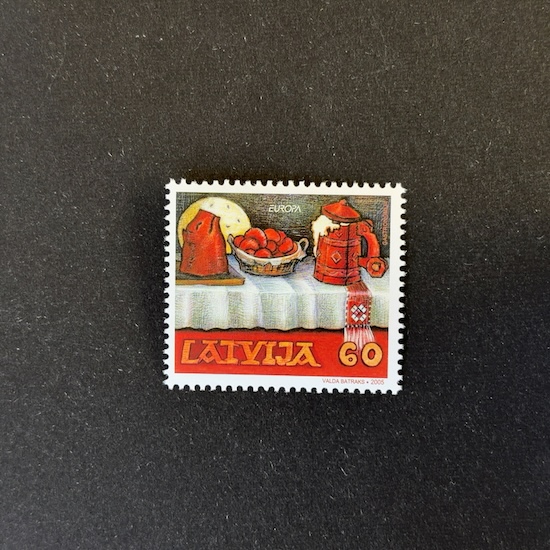
A warm, earthy still life by artist Varda Batlaka: bread, fruit, red ceramics, and embroidered folk cloth. “Food is culture itself” — expressed with beautiful simplicity. Rye bread, smoked fish, and potato dishes form the foundation of Latvian cuisine, and this stamp radiates the warmth of that tradition.
34 🇱🇮 Liechtenstein
A Comic Banquet Scene
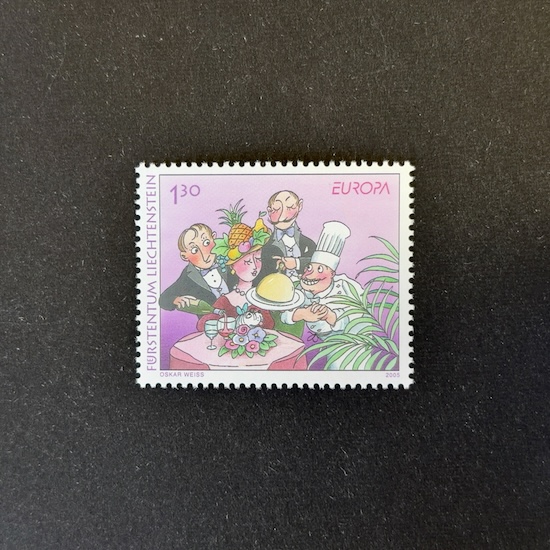
A humorous illustration by artist Oscar Weiss: formally dressed gentlemen and ladies wait as a chef in a toque prepares to lift a silver cloche. Käseknöpfle (cheese dumplings) and Spätzle (egg noodles) — shared with Swiss and Austrian traditions — are the heart of Liechtenstein’s cuisine.
35 🇱🇹 Lithuania
White Cottage Cheese and Black Bread
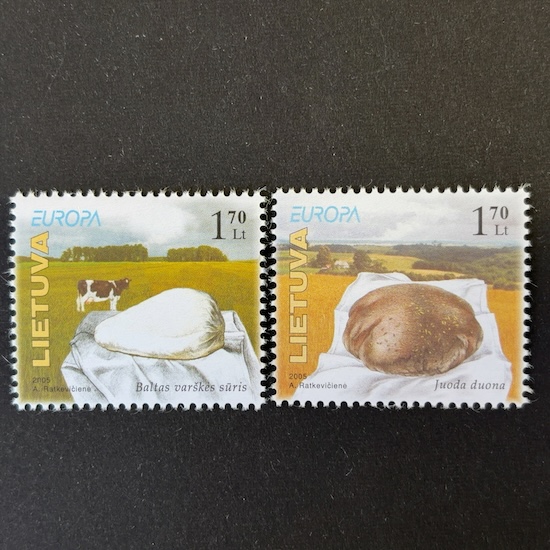
Against a summer meadow with dairy cows: “Baltas varškės sūris” (white cottage cheese); against an autumn field: “Juoda duona” (black bread). These two foods placed directly on a linen cloth embody Lithuania’s pride in its agricultural heritage. Black rye bread and cottage cheese with roots stretching back millennia — a beautiful expression of land and food.
36 🇱🇺 Luxembourg
Judd and Feierstengszalot
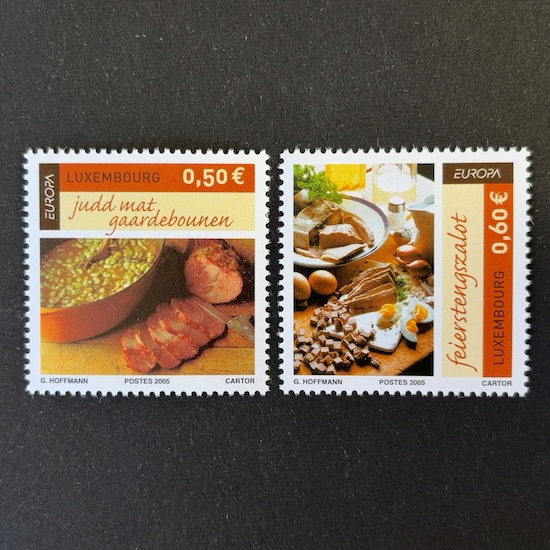
Two dish photographs:
- Judd mat Gaardebounen — smoked pork neck with broad beans: Luxembourg’s national dish
- Feierstengszalot — roast beef salad: a traditional starter
Judd is especially enjoyed in early summer when fresh beans are in season. A country where French, German, and Belgian food cultures all converge.
37 🇲🇰 North Macedonia
Paprika and Tavče Gravče
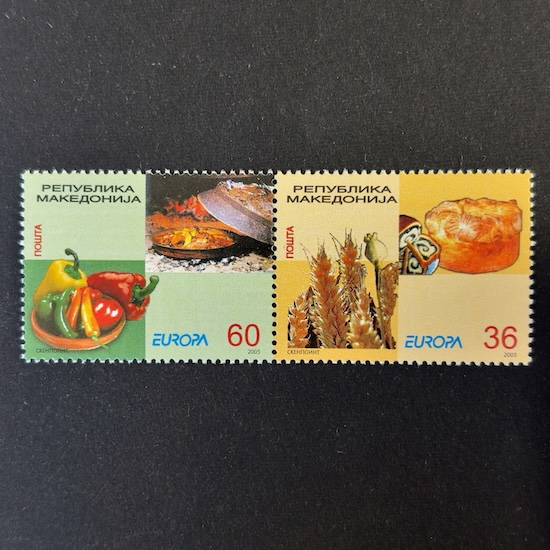
Colourful peppers, a clay pot, wheat ears, and bread. The clay pot dish Tavče Gravče (white bean casserole) is the most beloved national dish of North Macedonia — a true people’s food. The rich food diversity of the Balkans, blending Mediterranean, Turkish, and Slavic influences, comes through in every detail.
38 🇲🇹 Malta
Stuffed Vegetables and Rabbit Stew
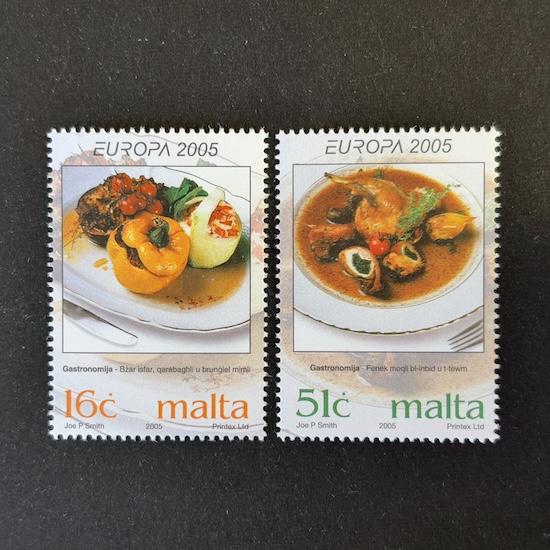
Two dish photographs:
- Bżar isfar, qarnabgħi u brunġiel mimli — stuffed yellow pepper, cauliflower, and aubergine
- Fenek moqli bl-inbid u t-tewm — rabbit fried with wine and garlic
Rabbit (Fenek) is Malta’s most iconic national dish. Malta’s composite culinary culture — shaped by Phoenician, Roman, Arab, Norman, Spanish, and British rulers — lives on today in its kitchens.
39 🇲🇩 Moldova
Mămăligă and Traditional Pottery
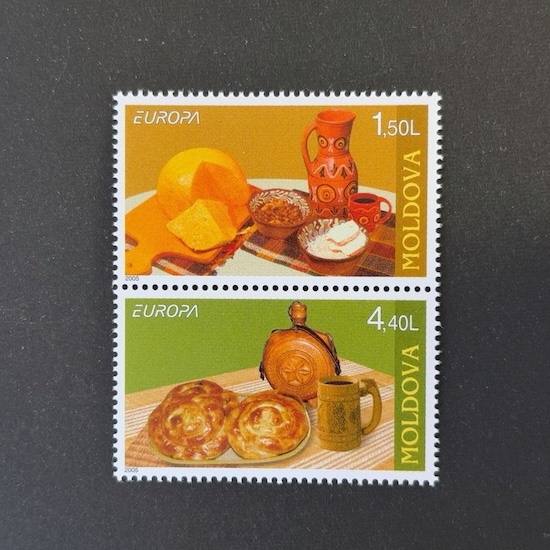
Yellow cornmeal polenta “Mămăligă,” a clay pot, and a spiral bread. Sharing language and culture with Romania, Mămăligă is the national dish of both countries. Moldova is also home to the world’s largest wine cellar, Mileștii Mici (Guinness certified), making it one of Eastern Europe’s greatest wine producers. Simple food, rich land.
40 🇲🇨 Monaco
Four Traditional Monaco Dishes
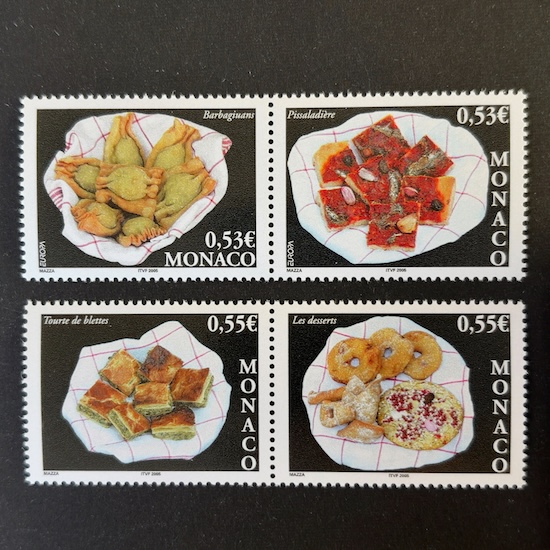
Monaco presents four traditional dishes:
- Barbaguans — fried rice and ricotta pastry parcels
- Pissaladière — onion and anchovy flatbread
- Tourte de blettes — Swiss chard pie
- Les desserts — traditional cookies and pastries
The flavours of the Côte d’Azur where French and Ligurian Italian cuisines meet — presented on elegant white plates.
41 🇳🇴 Norway
Food as Art Photography
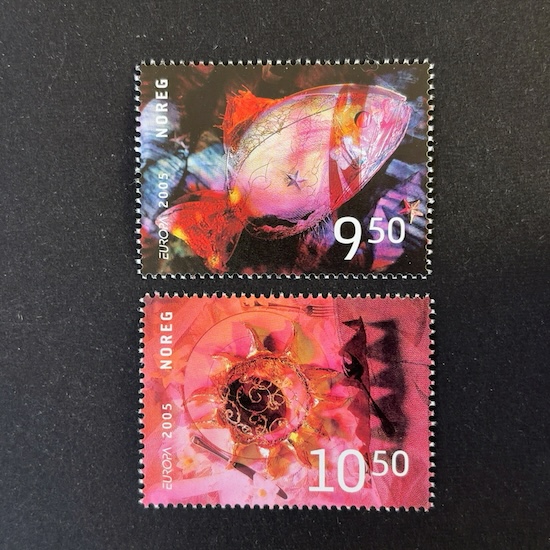
Vivid magenta and pink art photography — a pair of stamps that depict not food itself but the aesthetic experience of eating. A distinctly avant-garde approach from Norway. The world’s largest farmed salmon exporter, Norway’s fishery culture — born alongside the fjords — is folded quietly into these artistic stamps.
42 🇵🇱 Poland
Oscypek Cheese
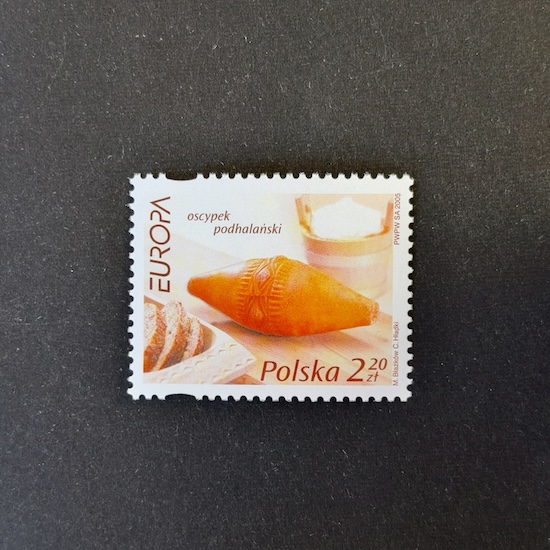
Smoked ewe’s milk cheese “Oscypek podhalański” made by Tatra Mountain shepherds — a spindle-shaped cheese with distinctive decorative patterns, holding EU PDO (Protected Designation of Origin) status. Lightly grilled over charcoal at mountain lodges. A stamp that speaks of pastoral mountain culture in southern Poland.
43 🇵🇹 Portugal (mainland)
Cozido à Portuguesa and Bacalhau Assado
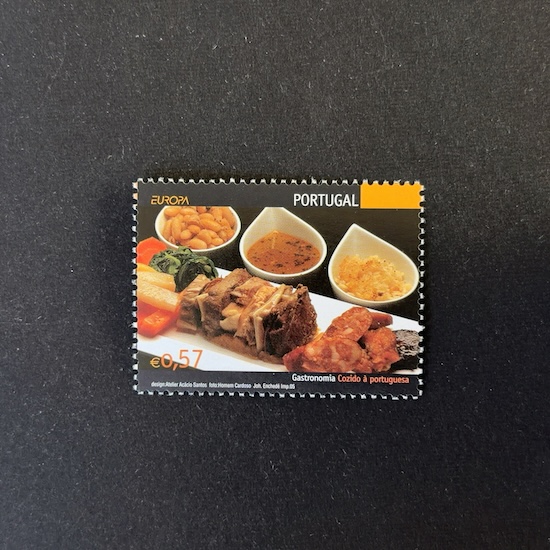
“Cozido à portuguesa” (€0.57) — salted pork, chicken, sausages, vegetables, and pulses slow-cooked together: Portugal’s pot-au-feu, a Sunday family favourite with countless regional variations.
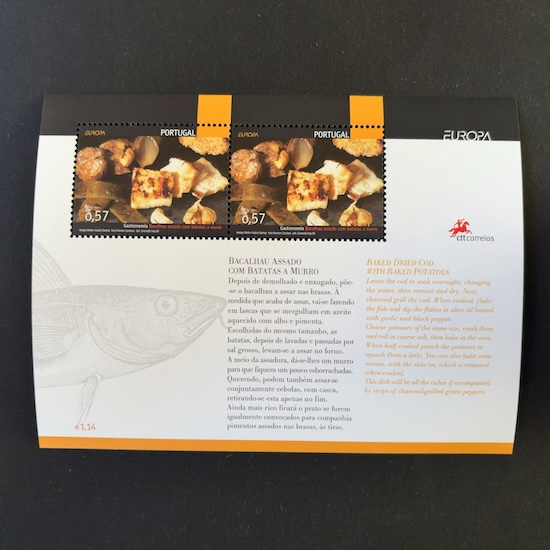
“Bacalhau Assado com Batatas a Murro” — charcoal-grilled salt cod with oven-smashed potatoes, with the recipe printed in Portuguese and English on the sheet margin. Portugal’s love of bacalhau is legendary: the saying goes there are 365 ways to cook it — one for every day of the year. Dried salt cod was the great sustainer of Age of Discovery ocean voyages, and remains the soul ingredient of Portuguese cooking.
44 🇵🇹 Portugal — Azores
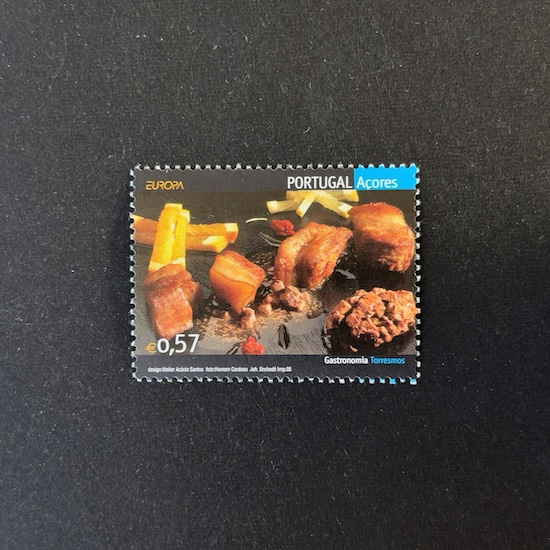
“Torresmos” (€0.57) — fried pork belly, a traditional dish indispensable at Christmas and festivals on the Azores islands. The archipelago also has unique geothermal cuisine, including the Cozido das Furnas stew cooked in volcanic earth.
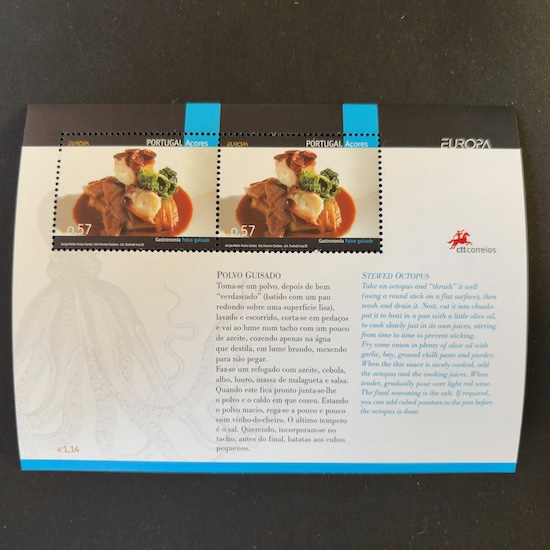
“Polvo Guisado” (€1.14) — octopus braised with olive oil, onion, bay leaf, and chilli paste. A recipe miniature sheet.
45 🇵🇹 Portugal — Madeira
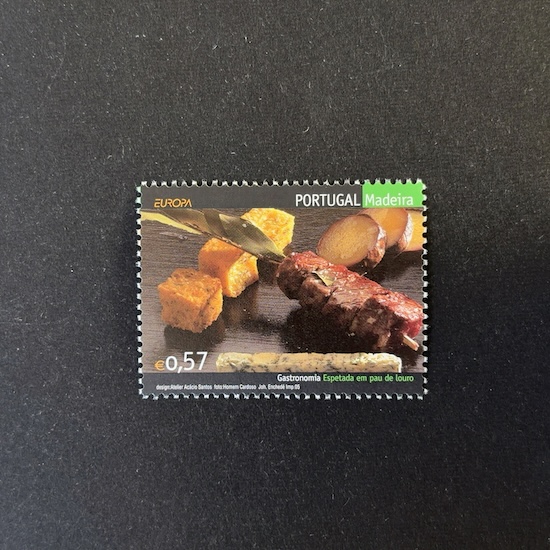
“Espetada em pau de louro” — beef skewered on bay laurel branches and grilled: the aromatic wood infuses the meat with its fragrance. An essential dish at Madeiran festivals.
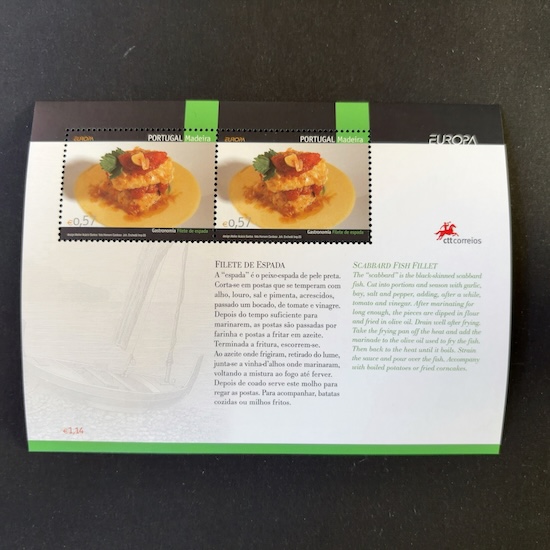
“Filete de Espada” — fillet of black scabbardfish with recipe sheet. The deep-sea scabbardfish is Madeira’s most important fish, typically served alongside fried banana — the sweet-savoury combination is uniquely Madeiran.
46 🇷🇴 Romania
Ancient Maps and Traditional Cuisine
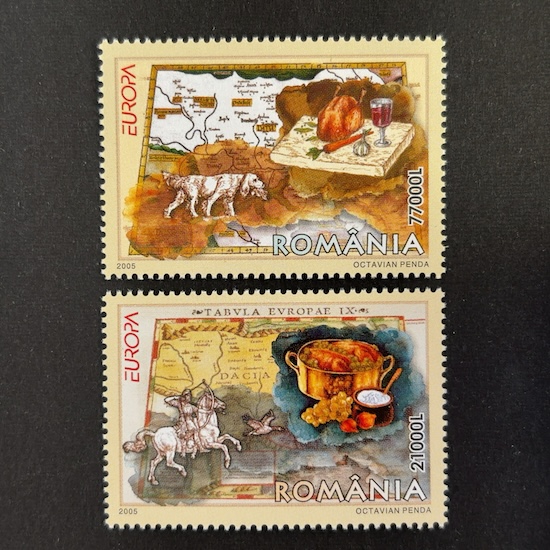
A pair of stamps combining a medieval map of ancient Dacia (present-day Romania) labelled “TABVLA EVROPAE IX” with a traditional cooking pot. A clever intellectual design layering history and food culture. Romanian cuisine — Sarmale (stuffed cabbage rolls), Mici (herbed minced meat grilled), Mămăligă (polenta) — has its own distinct character.
47 🇷🇺 Russia
Blini and Samovar
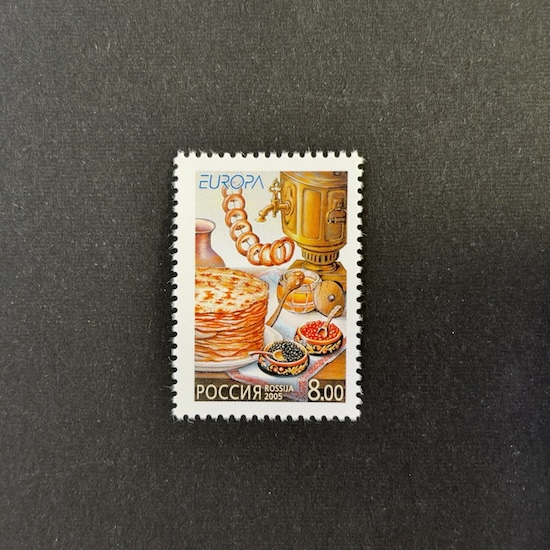
A golden Samovar at the centre, surrounded by Blini (thin pancakes), red and black caviar, and ring breads (Baranki). Blini are the traditional food of Maslenitsa (Pancake Week), their round shape symbolising the sun. Caviar — “black gold” — and the tea culture of the Samovar flourished in the 19th century. The essence of the Russian table in a single stamp.
48 🇸🇲 San Marino
Wood-Fired Bread and Wine
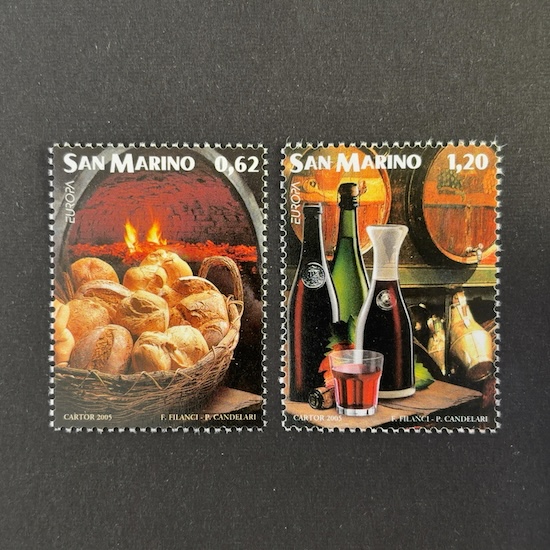
A glowing wood-fired oven with a basket of bread, and wine barrels in a cellar. The world’s oldest republic, San Marino is deeply influenced by Italian cuisine. It also has its own local specialities, including “Nidi di Rondine” (Swallows’ Nests), a rolled pasta dish. Bread and wine together evoke a medieval banquet.
49 🇷🇸 Serbia and Montenegro
Pumpkin Dish and Fish Salad
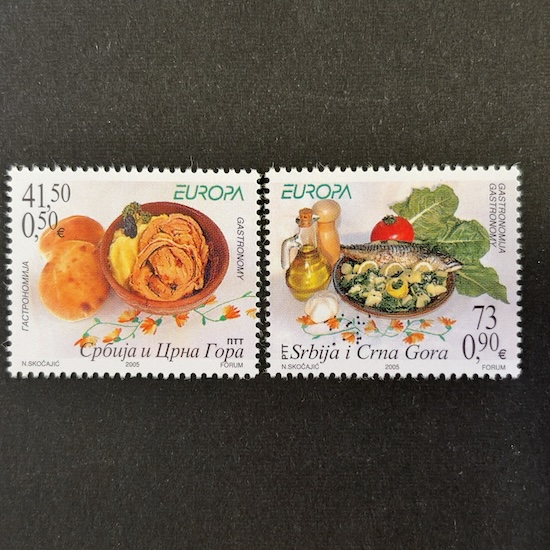
Stamps from the two countries then forming a federation: a clay pot pumpkin dish and a fish salad with olive oil dressing. Balkan cuisine is known for Ćevapi (grilled minced meat), Burek (pastry), and Ajvar (roasted pepper paste). The Adriatic coast (Montenegro side) brings a Mediterranean lightness to the stamps.
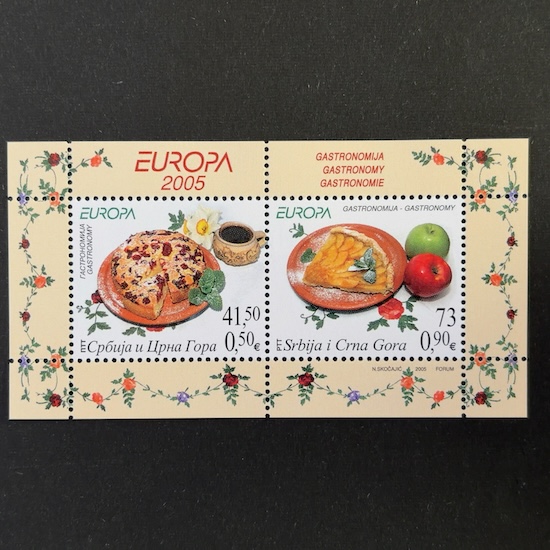
A decorative miniature sheet with floral borders showing a berry fruit cake and apple pie — folk embroidery patterns frame the pastries in a celebration of both food and culture.
50 🇸🇰 Slovakia
Bread in the Shape of Slovakia
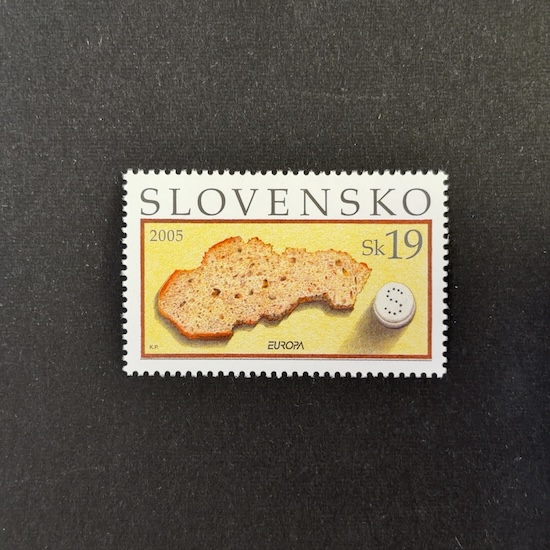
Against a yellow background: a rye loaf baked in the exact shape of Slovakia’s national territory, alongside a salt cellar. This embodies the Slavic tradition of welcoming guests with bread and salt. Slovakia’s national dish, Halušky (potato gnocchi with Bryndza sheep’s cheese and bacon), is beloved across the country. This stamp became one of the most talked-about in the entire EUROPA 2005 series.
51 🇸🇮 Slovenia
Potica
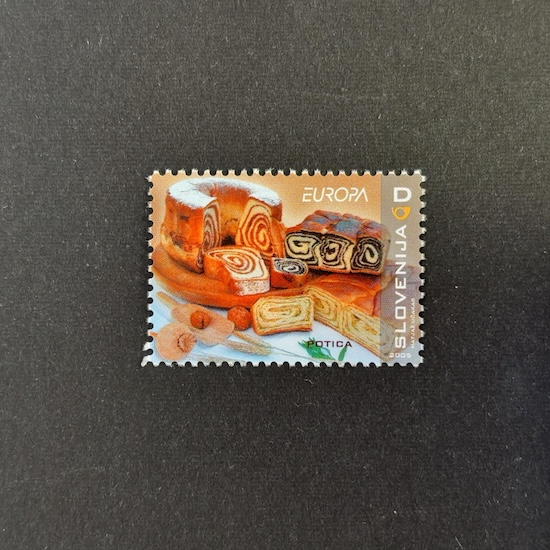
The word “POTICA” alongside rows of the traditional Slovenian rolled sweet bread — filled with walnuts, apricot kernels, or other fillings, rolled into a cylinder shape. An essential celebration food at Christmas and Easter, and a proud part of Slovenian cultural heritage. Fillings vary by region: walnuts, poppy seeds, hazelnuts, tarragon. A rich confectionery tradition shaped by the meeting of Italian, Austrian, and Balkan influences.
52 🇪🇸 Spain
Gazpacho and Paella
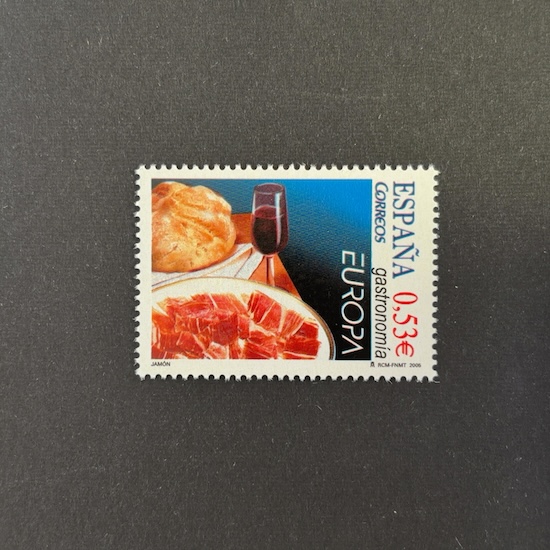
Two stamps representing Spanish cuisine: Gazpacho — the cold Andalusian tomato soup served in a clay bowl — and Paella, Spain’s iconic saffron-coloured rice dish cooked in a wide, shallow pan over fire. Both have roots in the Al-Andalus era and the Moorish agricultural legacy of introducing tomatoes, peppers, and rice to Spain’s fertile soils. Bold, sun-drenched, deeply satisfying.
53 🇸🇪 Sweden
Smörgåsbord
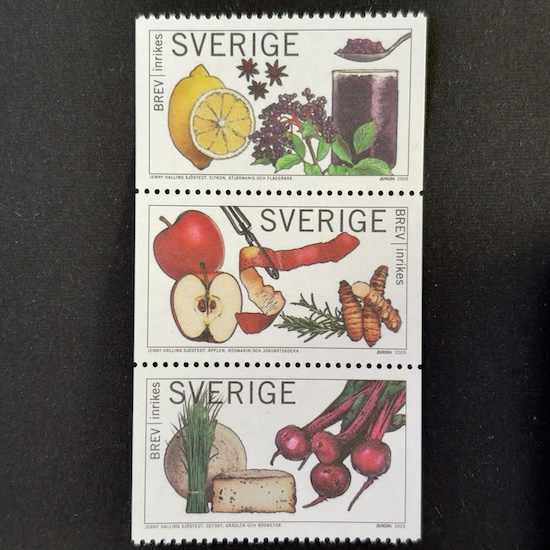
An abundant Smörgåsbord spread — herring, smoked salmon, meatballs (Köttbullar), Jansson’s Temptation, crispbread, butter — rendered in vibrant full-colour illustration. The word “Smörgåsbord” literally means “bread-and-butter table” and has entered many languages as the word for a lavish buffet spread. The stamps capture both the abundance and the conviviality of the Swedish table.
54 🇨🇭 Switzerland
Cheese and Fondue
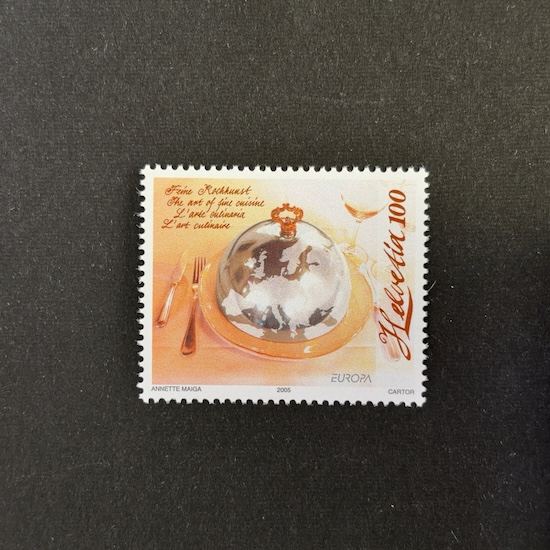
A fondue set with melted cheese and bread cubes, alongside a wheel of Swiss cheese: Emmental with its famous large holes is the world’s most recognised Swiss cheese, though Gruyère — without holes, meltingly rich — is the authentic choice for fondue. Switzerland has some 450 varieties of cheese, and the fondue tradition of sharing a pot around the table goes back to the Alpine herdsmen of the 18th century. Quintessentially Swiss.
55 🇹🇷 Turkey
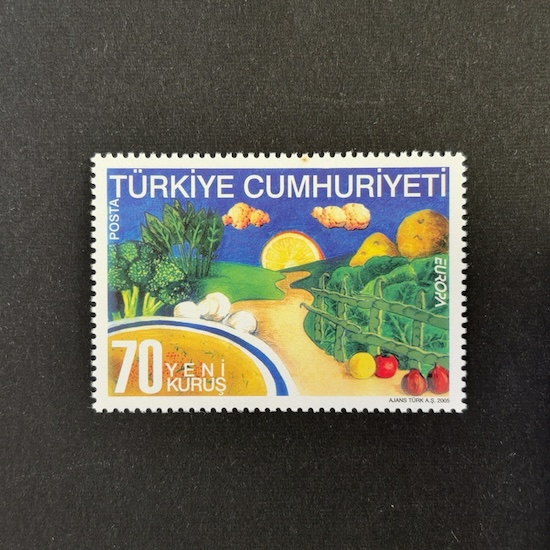
Meze and Baklava
Two stamps: a colourful spread of Meze — the small shared dishes that begin every Turkish meal (hummus, stuffed vine leaves, yogurt, aubergine) — and golden Baklava, the honey-and-pistachio filo pastry that is perhaps Turkey’s most internationally known sweet. Turkish cuisine bridges the Middle East, Central Asia, and the Mediterranean in one table. A magnificent, generous, endlessly varied culinary tradition.
56 🇺🇦 Ukraine
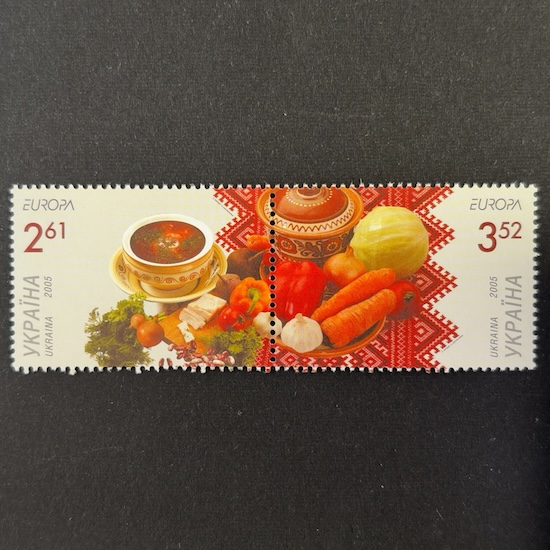
Borscht and Varenyky
Two national treasures: Borscht — the deep crimson beetroot soup — and Varenyky — the filled dumplings related to Polish Pierogi, served with sour cream. In 2022, UNESCO added Ukrainian Borscht to its intangible cultural heritage in need of urgent safeguarding. The dish traces its origins to Kyivan Rus’, making it one of the oldest documented dishes in European culinary history. These stamps carry a weight they couldn’t have known in 2005.
57 🏴 United Kingdom — Wales
Welsh Lamb and Leek
Wales issued its own stamps within the UK set: a rack of Welsh Lamb with vegetables, and the national symbol of Wales, the Leek. Welsh lamb, raised on the hills and mountains of Snowdonia, is prized for its flavour. The leek has been a symbol of Wales since the 7th century — St. David reportedly instructed Welsh soldiers to wear leeks in their hats to distinguish themselves in battle. Food as identity, on a stamp.
58 🇻🇦 Vatican City
Papal Table
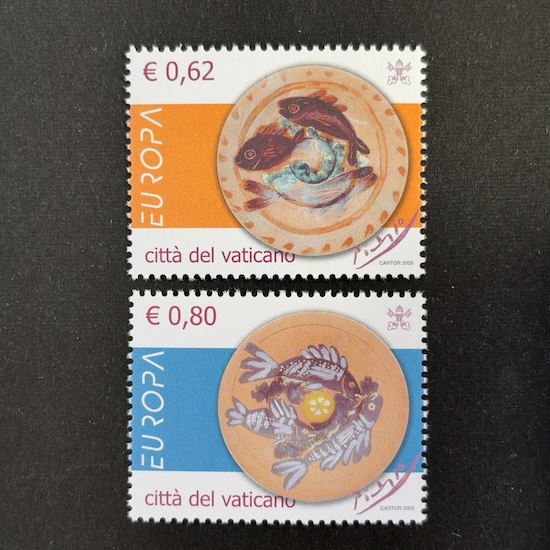
The final country in our tour: Vatican City’s stamps show a formal dining scene inspired by historical paintings of the papal court — a richly set table, silver candlesticks, ornate tableware. Vatican cuisine has been influenced by Italian cooking, particularly Roman cuisine, but also carries international influences from the many nations represented in the Holy See’s global community. A fittingly ceremonial end to our culinary journey across Europe.
A Feast in 58 Stamps
From Armenia’s dried fruits to Vatican City’s papal dining table — the 2005 EUROPA Gastronomy series offered a remarkable window into the food cultures, histories, and identities of 58 countries across Europe and beyond.
What strikes me most is how each stamp is not just a picture of food but a concentrated portrait of a country: its landscape, its history, its people’s relationship with the earth and the table. Bread baked in the shape of Slovakia. A recipe printed on Portugal’s sheet margin. Norway’s avant-garde food photography. Slovakia’s bread shaped like a country. The tradition of the Slovak welcomings with bread and salt.
Philately as gastronomy. A feast in 58 stamps.
If any of these stamps caught your eye, Postio Marche carries a curated selection of EUROPA stamps — including items from the Gastronomy series. Take a look!
👉 Postio Marche — Food Stamps Collection
Curious about the full history of EUROPA stamps and how the series works? Read our overview article:
👉 Celebrating 70 Years of EUROPA Stamps: Everything You Need to Know
Images and text are original. Please do not reproduce without permission. Some stamps shown are from a private collection.
This blog covers stamp designs and art from around the world. Follow us on social media for daily stamp art and gallery visits!
Twitter: @postio_marche
Instagram: mylittleart_studio
Online stamp shop: Postio Marche