Hello, everyone!
Alfons Mucha has devoted fans all around the world, and I count myself among them. Over the years I’ve attended exhibitions and read books exploring his work in depth.
The 2017 “Mucha” exhibition at the National Art Center Tokyo displayed all 20 paintings from his monumental cycle The Slav Epic — a series he created to honor his homeland.
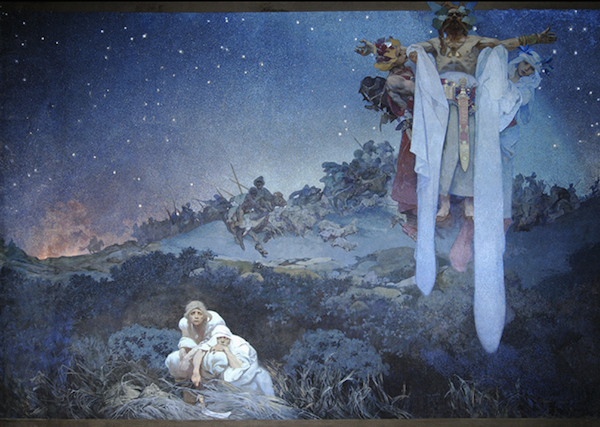
The first painting in the cycle, “The Slavs in Their Original Homeland,” measures an astounding 610 cm × 810 cm — its sheer scale was simply overwhelming to stand before.
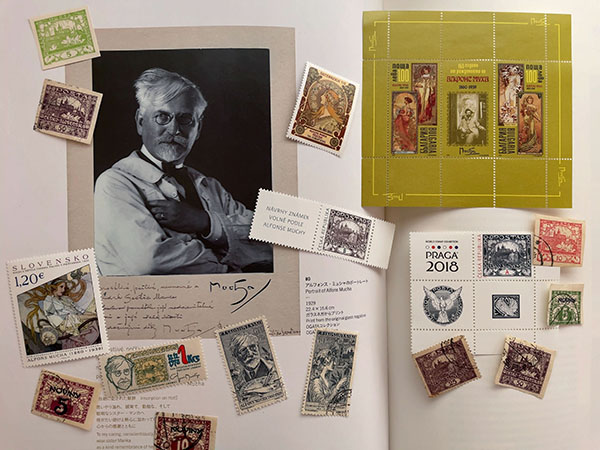
Alongside The Slav Epic, the exhibition also featured stamps designed by Mucha, presented as part of the context of who he was as a person and artist.

When Czechoslovakia was founded in 1918, it was Mucha who designed the country’s very first stamps.
Today I’d like to explore the world Mucha packed into a tiny 3 cm × 2 cm space — his stamp designs.
About Alfons Mucha
Profile
Alfons Maria Mucha was born on July 24, 1860, in Ivančice, Moravia (in what is now the eastern Czech Republic), then part of the Austrian Empire.
The name “Mucha” is the French pronunciation; in Czech it would be rendered as “Muha” — though “Mucha” just feels more fitting, doesn’t it?
Speaking of Czech connections: Karel Svolinsky was born 36 years after Mucha, in 1896, in Olomouc in central Moravia — they were countrymen.
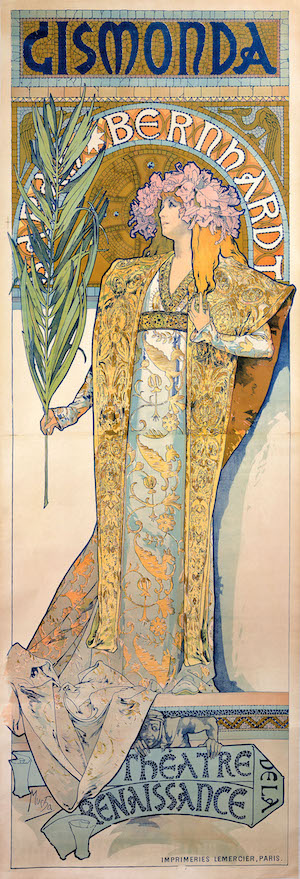
At 19, Mucha began working on stage sets in Vienna. His breakout came in 1895 with the poster Gismonda, created for the actress Sarah Bernhardt.
In 1896 he created The Four Seasons, and in 1897 Byzantine Heads (Brunette) and other decorative panels; in Paris he also worked as a book illustrator.
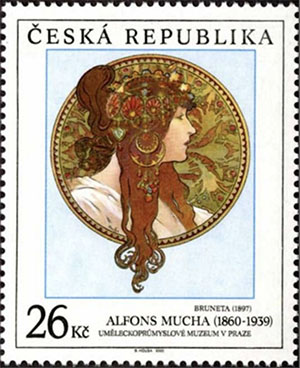
With financial backing from an American patron, Mucha returned to his homeland in 1910 and began work on The Slav Epic. The cycle took 20 years to complete.
The Slav Epic (Slovanská epopej) is a series of 20 monumental paintings Mucha worked on from 1910 to 1928. Depicting the mythology, legends, and history of the Czech and Slavic peoples, the works range from approximately 4 × 5 meters to 6 × 8 meters. The technique is primarily egg-based tempera with some oil paint. Upon completion, all 20 works were donated to the city of Prague in 1928. Since 2012, they have been housed on the ground floor of the Veletržní palác (Trade Fair Palace) of the National Gallery Prague.
Mucha passed away on July 14, 1939, at the age of 78 — just ten days before his 79th birthday.
The influence of war and political repression pushed Mucha into relative obscurity, but from the 1960s onward, the Art Nouveau revival brought his work to a worldwide audience.
Alfons Mucha’s Stamp Designs
Mucha’s First Stamp
In 1918, at the age of 58, Mucha designed the historic first stamps of Czechoslovakia.
After Czechoslovakia declared independence on October 28, 1918, the country continued using Austro-Hungarian stamps on a provisional basis. The new government, eager to issue its own stamps, approached Mucha — then a celebrated artist — with the commission.
Mucha accepted the assignment without charge, and on December 18, 1918, Czechoslovakia’s very first stamps were issued — Mucha’s first stamps as well.
December 18 has since been observed as “Stamp Day” in Czechoslovakia and later the Czech Republic, with a commemorative stamp issued each year.
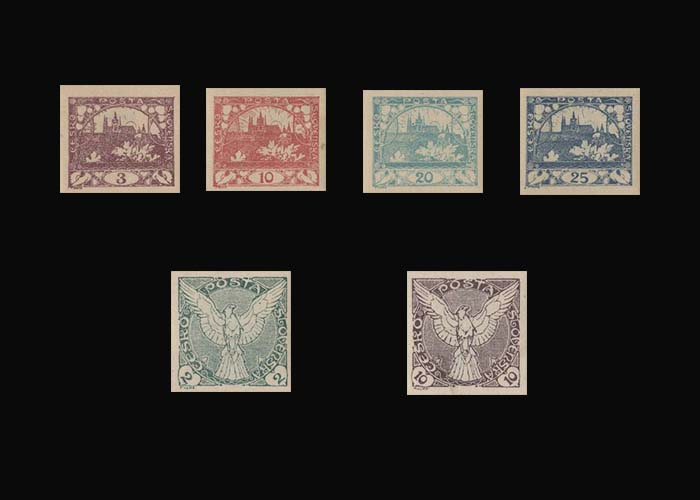
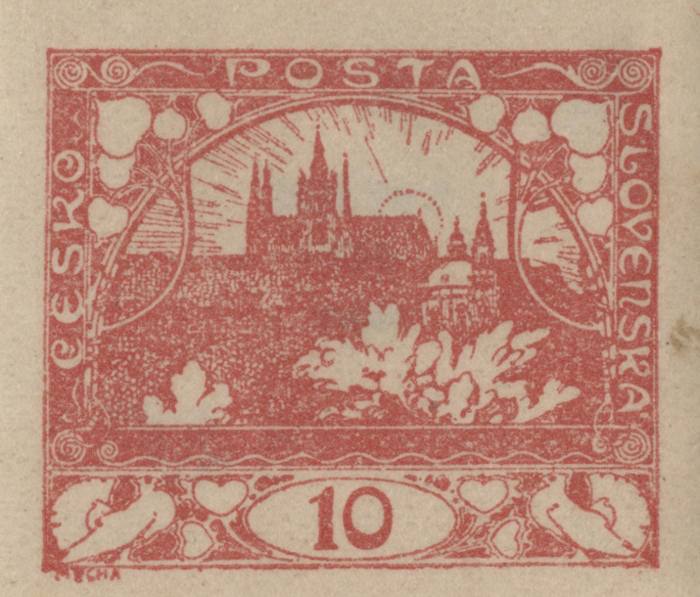
Due to limited funds and early printing technology, the initial printings show uneven ink and somewhat unclear results. Poor trimming was also common, leaving margins of varying widths — but look for the word “MUCHA” in the lower left corner.
In the photo above, the bottom row shows “newspaper stamps,” used to pay postage for mailed newspapers.
The Motifs Mucha Chose
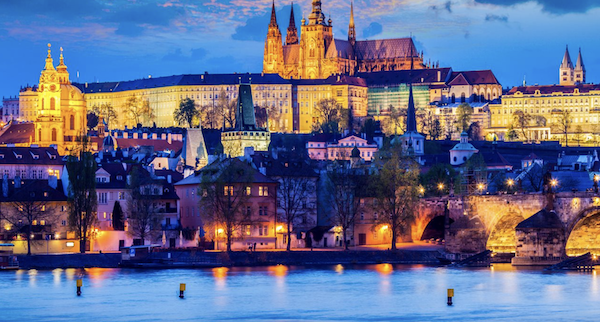
For the definitive stamps, Mucha’s first chosen motif was a view of Prague Castle — the symbolic heart of politics and culture at the time. The iconic structure at the center is St. Vitus Cathedral.
For the newspaper stamps, Mucha chose a hawk — the symbol of Slavic unity.
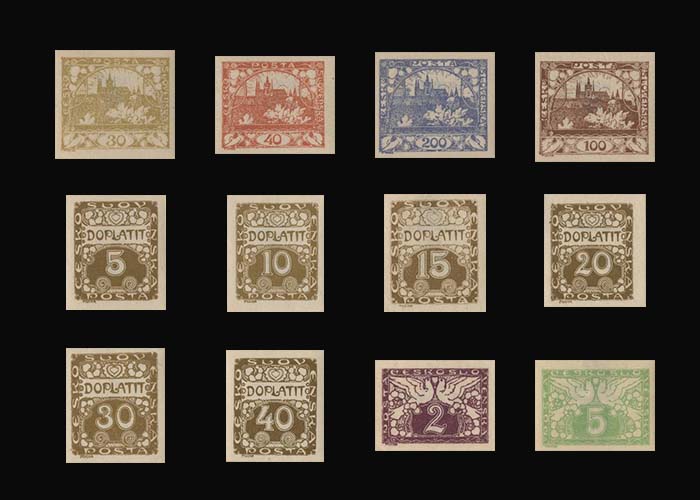
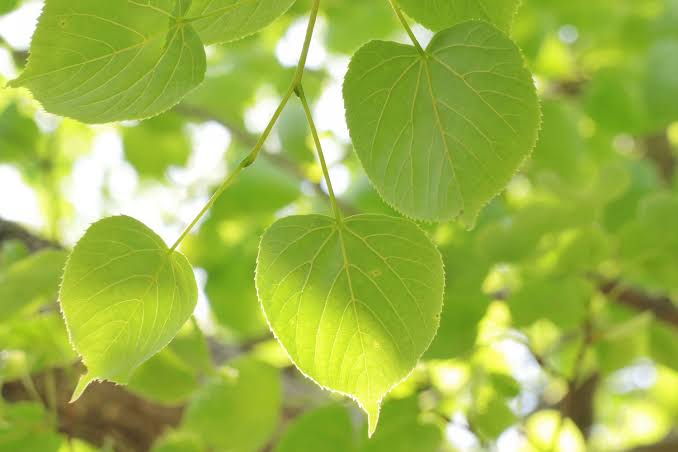
The stamps inscribed “DOPLATIT” (meaning “surcharge”), issued from February 1, 1919, are postage due stamps. Their motif is the linden tree — the national tree — recognizable by its distinctive heart-shaped leaves.
The two stamps in the third row on the right are express mail stamps, featuring a dove — the symbol of peace. All of these designs bear the unmistakable influence of Art Nouveau.
Mucha’s Evolving Stamp Designs
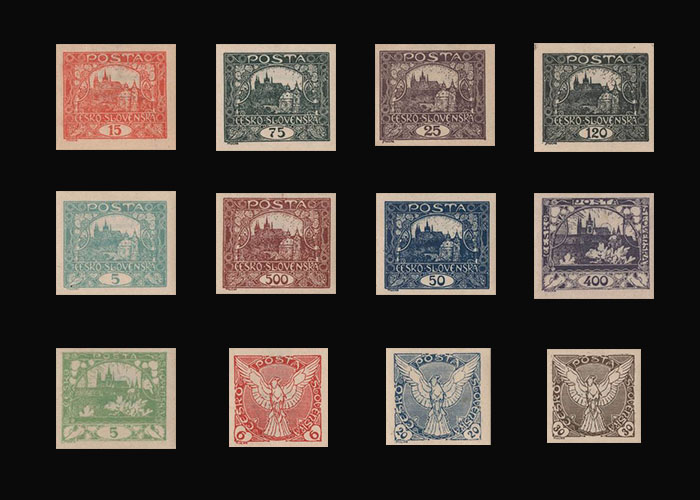
Look closely at the Prague Castle design, and you’ll notice that in the original 1918 printing, the sun was depicted to the right of St. Vitus Cathedral — a symbol of hope for the new nation. However, it was pointed out that this placement was geographically inaccurate (the sun would never be to the north). The sun appears in printings through March 14, 1919, but disappeared from April 10, 1919, onward.
In the first 1919 series, a large tree stands in front of Prague Castle; in the second series it is gone — only to reappear later. The country name “CHESKA SLOVENSKA” also shifted from vertical to horizontal lettering, then to white outline. The Castle itself grew increasingly detailed over successive printings. Spotting these differences is one of the great joys of stamp collecting.
Love for His Homeland — The Hussite Stamp
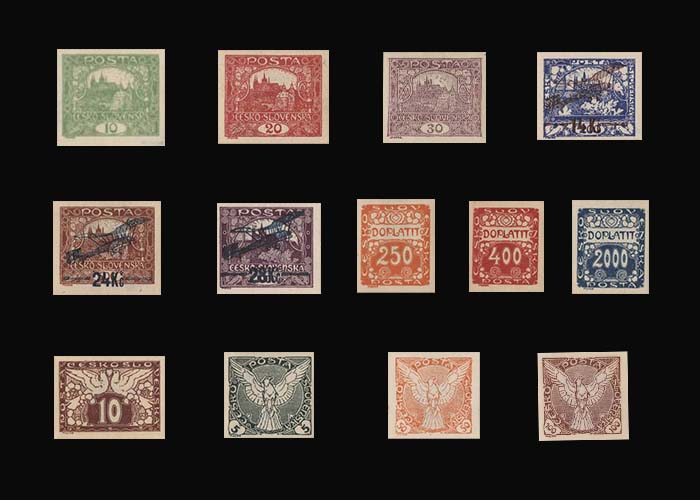
On June 5 and June 10, 1920, the second series of definitive stamps was issued: the “Hussite” design, successor to the Prague Castle series.
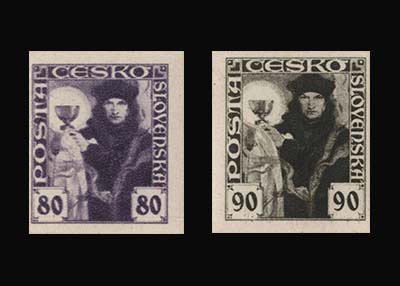
Prague Castle forgeries had been circulating widely, prompting the new design — but complaints from the Catholic Church meant only two values were issued, making this a short-lived series. The Hussite figure holds the Hussite chalice, their symbolic emblem, and the smoke of an incense burner is also depicted.
From 1921 onward, no new Mucha designs appeared; existing designs were used with overprinted surcharges.
Mucha’s Designs in Reissued Stamps
A 1995 stamp series titled Traditions of Czech Stamp Production, issued on January 20, 1995, takes Mucha’s newspaper stamp as its motif.
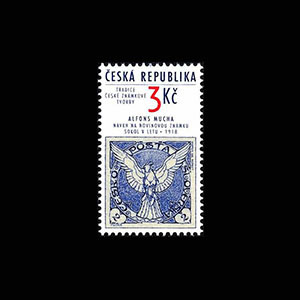
One hundred years after 1918, the Czech Republic issued stamps reviving Mucha’s original designs.
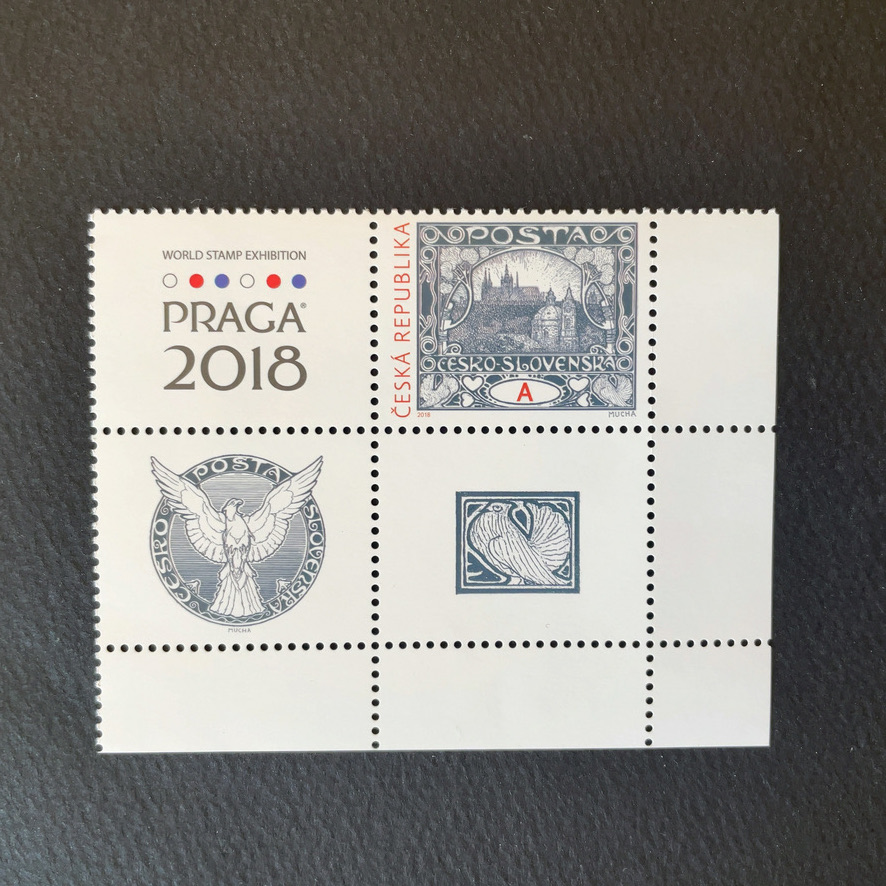
In 2020, another stamp featuring the Prague Castle motif was issued.
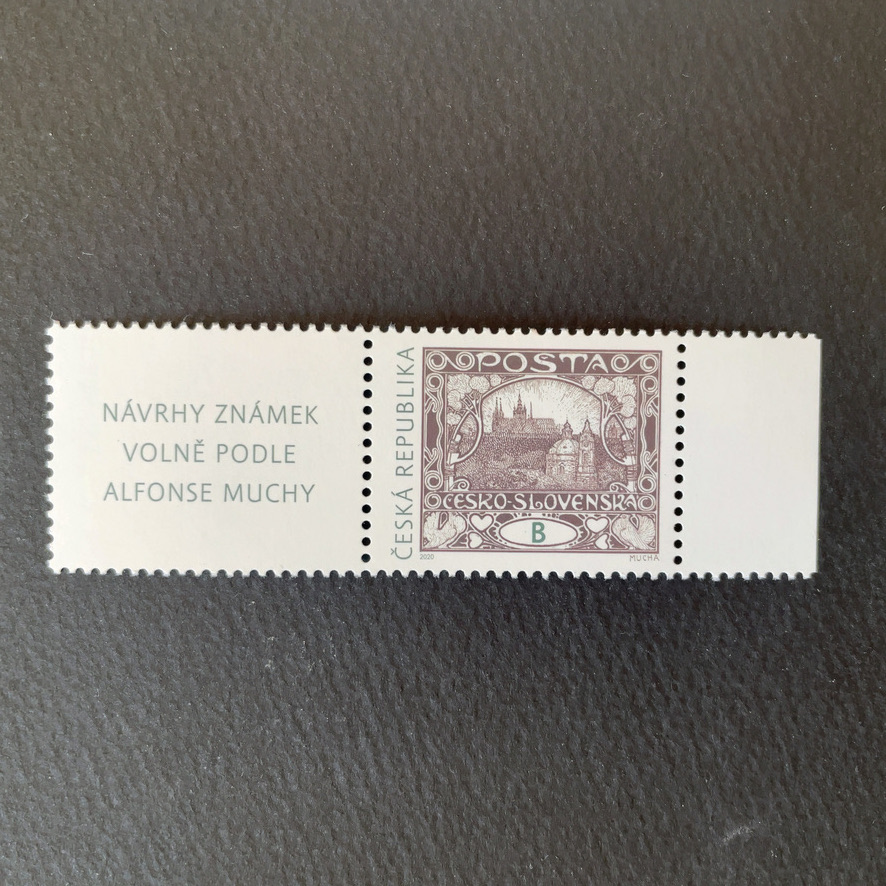
The denominations use the current “A” and “B” format, and the year is also printed. Interestingly, the “MUCHA” signature appears in the lower right corner — whereas in the original it was in the lower left. A small but intriguing difference!
Slovakia issued a Prague Castle stamp on December 18, 2018 — the 100th anniversary of that first Stamp Day — complete with a tab portrait of Mucha.
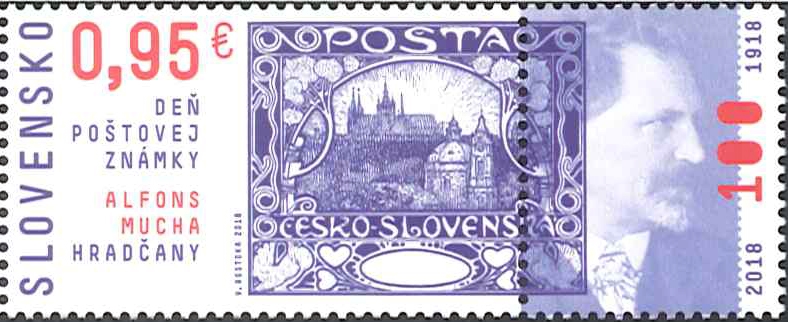
With modern printing technology, the Prague Castle design comes through in beautiful clarity.
What Mucha Did for His Homeland, and More
Beyond stamps, Mucha also designed banknotes. The girl depicted on the 10-koruna note was modeled after his own daughter, Jaroslava.
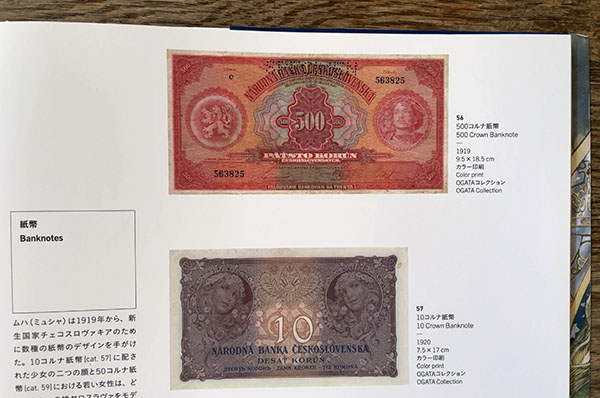
Mucha accepted the stamp designs, banknotes, the national coat of arms, and police uniforms — all without compensation. It’s easy to picture him pouring his love for his country into every detail, designing with care and devotion, wishing only for the nation to flourish.
♪ Come visit the Artists section of Postio Marche to find stamps featuring Mucha and other great artists!